

A Guide to Renting Office Space in Japan for Businesses in 2026
 Updated on January 19
 Verified by GLA Experts
 Follow GLA on

content
- 1. Why should businesses rent office space in Japan?
- 2. Four types of office spaces for rent in Japan suitable for foreign businesses.
- 3. Things to note when renting office space for businesses operating in the professional services sector.
- 4. Legal requirements regarding office space when establishing a company and applying for a Business Manager Visa in Japan (Updated 2026)
- 5. Office rental costs in Japan
- 6. Other expenses to consider besides office rent in Japan.
- 7. How does GLA support businesses in renting office space in Japan?
- 8. Frequently asked questions when renting office space in Japan?

 Follow GLA on

Renting office space in Japan is not just about finding a place to work; it also impacts your ability to register a business, open a bank account, build brand reputation, and optimize operating costs.
However, not all foreign businesses need to rent traditional office space.
Depending on their size, budget, and business objectives, companies can flexibly choose between virtual offices, coworking spaces, serviced offices, or traditional offices.
In this article, GLA will analyze four common types of office rentals in Japan to help foreign companies understand the advantages and disadvantages of each type, important considerations before signing a contract, and choose the most suitable solution when expanding operations in the Japanese market.
1. Why should businesses rent office space in Japan?
Businesses should rent office space in Japan because it's not just a workplace, but also a crucial condition for... open a companyThis includes assisting with Business Manager Visa application, building credibility with partners, and creating a foundation for business expansion.
Japan is the world's fourth-largest economy with a GDP of approximately US$4,38 trillion (2026) and over 126 million high-purchasing power consumers.
Thanks to its stable business environment, modern infrastructure, and international connectivity network, Japan continues to be an attractive destination for foreign businesses looking to expand their operations in Asia.
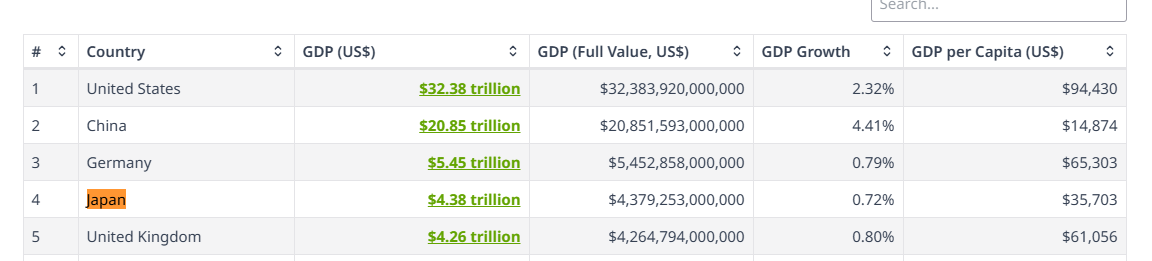
Japan's GDP size in 2026 (Source: Worldomet is)
To take advantage of the opportunities in this market, many businesses choose to open a company or expand their presence in Japan.
In this context, renting a suitable office space not only meets legal requirements but also contributes to enhancing brand image, building trust with customers and partners, and supporting long-term business operations.
Here are some reasons why many foreign companies choose to rent office space in Japan.
| Benefits | Significance for Businesses |
| Meet the requirements when set up company in japan |
Businesses should refer to this article: Open an agency in Japan. To learn more about the requirements and procedures for establishing a company in Japan. |
| Assistance with the Business Manager Visa application process. |
|
| Enhance your reputation with customers and partners. |
|
| Convenient for operational activities and personnel recruitment. |
|
2. Four types of office spaces for rent in Japan suitable for foreign businesses.
Before choosing an office space, businesses should clearly define the following:
- Has the company established a legal entity in Japan yet?
- Does the office address need to meet the business registration requirements?
- Does the business need to receive clients regularly, or does it simply need a business address?
- How many employees does the company have working in Japan?
- Do you need to use meeting rooms, reception services, or mail receiving and forwarding services?
- Does the business require a physical office space according to legal regulations or licensing conditions?
- What is the monthly budget for office rent and operating expenses?
After clearly identifying their needs, businesses can choose one of four common types of offices in Japan: Traditional Office, Serviced Office, Virtual Office, and Coworking Space.
Below is a comparison table of the key criteria for four types of offices to help businesses choose the option that best suits their business needs.
| Criteria | Traditional office | Service Office | Virtual office | Coworking space |
| Working space | Private office | Private office, fully furnished. | No fixed workspace. | Shared workspace or private office (depending on the package) |
| Initial cost | Cao | Medium | Low | Low |
| Register your company address. | Have | Usually permitted | Depending on the supplier and intended use. | Depending on the supplier |
| Suitable for Business Manager Visa | Have | Yes (if you have a private office that meets the requirements) | No | No |
| Suitable Object | Long-established businesses with a large workforce. For example: Restaurant, cafeSpa, nail salon, clinic, law office, real estate company, showroom, training center, etc. | Newly established businesses, representative offices, foreign companies Examples: Consulting firms, trading companies, IT companies, import/export companies, fintech companies, companies opening branches in Japan. | Startups, freelancers, and market research companies. Examples include: marketing agencies, software companies, design firms, media companies, consulting firms, and online service providers. | Startups, project teams, and businesses need a flexible work environment. Examples: Foreign companies with international business operations, e-commerce companies, Amazon Japan, Rakuten, B2B businesses, and companies conducting market research in Japan. |
1. Traditional Office
A traditional office is a type of business where a company leases a private office space in a commercial building under a medium- or long-term contract.
When renting a traditional office, businesses have independent workspace and can arrange furniture and work areas according to their needs.
However, all renovation, construction, or structural modification activities must comply with the building owner's regulations and Japanese law.
| Write comment here... | Details |
| Advantages |
|
| Limit | The cost of rent, security deposit, and office finishing is relatively high. Most lease agreements require the premises to be returned to their original condition (Genjō Kaifuku) upon contract termination, resulting in additional costs for businesses incurring dismantling and restoration expenses. Any changes to the floor plan or partition installation must comply with strict fire safety regulations and building management rules. |
| suitable for | The company is well-established, has long-term growth plans in Japan, requires private workspace, and has sufficient resources to cover rental, operating, and building management costs. |
Before signing a traditional office lease agreement in Japan, businesses should carefully review the terms and conditions related to:
- Cost of restoring to its original state (Genjō Kaifuku).
- Regulations regarding office renovation and construction.
- Fire safety requirements.
- Expenses incurred during the rental period.
- Conditions for termination, renewal, and obligations under the contract.
Businesses should request that the building owner or landlord provide all relevant documents, quotations, and regulations to proactively assess the total investment cost and avoid unexpected expenses during operation or at the end of the lease agreement.
2. Virtual Office
In Japan, a virtual office is not a physical office space but rather a service that provides a business address along with supporting amenities such as mail receiving, parcel forwarding, and other additional services as needed.
Essentially, a business does not rent a fixed workplace but uses a provided address for transactions, receiving mail, and in some cases, may register its business according to the provider's terms and conditions.
Services typically included in a virtual office package:
- Provide a business address: Provide a recognized physical address for company registration at the Japanese Legal Affairs Bureau if all address usage requirements are met.
- Mail and parcel reception: The provider receives mail, documents, or parcels sent to the virtual office address on behalf of the business.
- Mail forwarding: Assists in resending letters and documents to the company's physical address or a designated address.
However, a virtual office does not include a fixed physical workspace, unless the business subscribes to additional services.
This is a cost-effective solution suitable for startups, small and medium-sized enterprises (SMEs), freelancers, or foreign companies surveying the Japanese market before investing in a physical office.
Important note: If your company plans to apply for a Business Manager Visa, a virtual office will not meet the requirements of the Japan Immigration Bureau (ISA).
According to ISA regulations, visa applications must demonstrate that the business has an independent business location with a physical workspace separate from the residence and appropriate to the scale of operations.
Therefore, in this case, businesses should choose either a Traditional Office or a Serviced Office with independent workspaces from the outset to avoid incurring costs and time switching office types midway through the visa application process.
3. Serviced Office
Serviced offices are a type of private office space that is fully equipped with facilities and support services, allowing businesses to use the office immediately without further investment in furniture or office infrastructure.
This is a suitable option for foreign businesses that want to:
- Establish a company or open a representative office.
- Launching a business within a short period of time.
Compared to traditional offices, serviced offices help businesses shorten preparation time and significantly reduce initial investment costs.
However, before choosing a service office in Japan, you need to consider the following:
- Check if the office address is permitted for use in company registration.
- Verify that the office meets the business location requirements if the business intends to apply for a Business Manager Visa.
- Clarify which services are included in the rental fee and any additional charges such as meeting room use, parking, printing, or overtime work.
- Review the lease term, renewal conditions, contract termination, and related fees.
4. Coworking Space
Coworking spaces are a shared office model where multiple individuals/businesses share a workspace with common amenities such as desks, internet access, meeting rooms, printers, reception areas, and a pantry.
This is a popular option for startups, freelancers, and foreign businesses looking to quickly establish a presence in Japan at a reasonable cost.
Common seating types in Coworking Spaces:
- Flexible seating (Hot Desk): You can choose any empty seat in the shared workspace.
- Dedicated Desk: They use a fixed desk, often accompanied by a personal locker for storing documents and equipment.
- Phone Booth or Focus Booth: Soundproof space for online meetings, phone calls, or work requiring concentration.
3. Things to note when renting office space for businesses operating in the professional services sector.
Not all types of offices meet the operating requirements of professional service industries. For fields such as:
- Law firm, lawyer's office.
- Tax and accounting consulting firm.
- Real estate brokerage firm.
- Clinics, dental practices, and other medical facilities.
- Certain professions require professional licenses or specialized business permits.
Businesses need to carefully check the licensing authority's requirements before choosing an office.
Depending on the industry, the regulatory authority may require businesses to:
- We have a physical office in Japan.
- It is a private workspace, not shared with other businesses.
- The company sign is present at the registered location.
- Meet the requirements regarding area, facilities, or customer reception conditions as stipulated by each industry.
Therefore, virtual offices or co-working spaces may not meet the licensing requirements for certain industries.
Before signing an office lease agreement, businesses should verify the applicable legal requirements for their business sector to avoid any impact on the business registration or licensing process.
4. Legal requirements regarding office space when establishing a company and applying for a Business Manager Visa in Japan (Updated 2026)
An office is not simply a workplace; it's one of the mandatory legal requirements that determines whether a company registration application and a Business Manager Visa application will be approved.
Since 16/10/2025, Japan Immigration Bureau (ISA) Standards related to offices have been officially tightened, rendering many previously accepted models (such as virtual offices and free-address coworking spaces) unsuitable.
Businesses need to be aware of these changes before planning to lease office space in 2026.
1. Regulations before and after the reform (October 16, 2025)
According to the Official announcement regarding the revision of the provincial regulations on the "Business - Management" residence status. Under ISA, the standards for capital, personnel, and office space have changed significantly:
| Criteria | Before October 1, 2025 | From 16/10/2025 |
| Minimum registered capital | 5.000.000 JPY | 30.000.000 JPY |
| Request for permanent staff | Not mandatory (if sufficient funds are available) | A minimum of 1 full-time employee is required. |
| Virtual office / Coworking free-address | Some cases are subject to review. | Not accepted |
| Home Office | Each case may be reviewed individually. | In principle, it is unacceptable. |
| Evaluating business profiles | Expert appraisal is not mandatory. | Expert evaluation is needed (certified accountant, tax consultant, etc.). |
Two changes that directly affect office selection are:
- Increase investment capital requirements sixfold;
- Recruitment of full-time employees is mandatory.
These changes mean that businesses not only need a registered business address but also an office that meets their actual operational needs, with suitable space and facilities to arrange workspaces for managers and employees.
2. Why are virtual offices and free-address coworking spaces no longer accepted?
Follow the instruction Clarify the residency status standards for foreign businesspeople. According to ISA, businesses applying for a Business Manager Visa must demonstrate that business and management This is done in reality, through a physical business location (事業所の確保・存在), and not just on paper.
Virtual offices and free-address coworking spaces (without a fixed private room) do not meet this requirement for two reasons:
- There is no fixed physical workspace.A virtual office only provides an address for receiving mail; it does not have a physical workplace for authorities to verify business operations.
- No guarantee of exclusive use.With free-address coworking, businesses don't have a fixed, separate workspace, while from October 16, 2025, the office must also have enough space to accommodate at least one full-time employee, something that the flexible seating model (Hot Desk) cannot provide.
Therefore, if a business plans to apply for a Business Manager Visa, it should rule out these two models from the outset, opting instead for a serviced office or a traditional office with independent workspaces.
3. Why are home offices no longer accepted?
In principle, the ISA regulates the use of private residences as business premises. Not accepted, both before and after the 2025 reforms. The main reason:
- It is difficult to separate personal life from business activities.Authorities find it difficult to verify whether that address is actually used for business operations or is simply registered to legitimize visa applications.
- Failing to meet the standards of appropriate business scale.With the new requirements for full-time employees and a minimum registered capital of 30 million yen, a typical apartment or house would find it difficult to demonstrate sufficient operational capacity for the scale of business required.
A rare exception might be considered if the property has a completely separate area exclusively for business use (e.g., with a separate entrance, space entirely independent from living quarters), but in practice very few such applications are approved, so businesses should not bet on this option.
4. Independent office space, separate from living quarters, and sufficient space for employees.
Based on the above regulations, an office that meets the requirements to register a company and apply for a Business Manager Visa in 2026 must simultaneously satisfy the following criteria:
- There is a valid address for registration at the Department of Justice.: Meeting the requirements for registering the company's registered address (本店所在地) according to the procedure Commercial registration - legal entity at the Legal Affairs Bureau of Japan.
- A separate workspace with clearly defined boundaries.: Separate from personal living spaces or shared spaces with other businesses.
- Used continuously and for a long period of time.This does not mean the meeting room is rented by the hour or that it is for short-term use.
- Sufficient space to accommodate a manager and at least one full-time employee.: Meeting the mandatory recruitment requirements under the new regulations.
- This can be proven by a valid lease agreement.Registered under the company name (not an individual), clearly stating the purpose of use as a business office.
With these standards, Traditional office , and The service office has private rooms. These are the two most suitable options for businesses planning to apply for a Business Manager Visa.
5. Office rental costs in Japan
Office rental costs in Japan vary greatly depending on the office model, geographical location, usable area, and amenities included.
In major cities like Tokyo, Osaka, or Yokohama, costs are typically higher due to high demand for office space, especially in key business districts such as Marunouchi, Shinjuku, Shibuya, Minato, or Chiyoda.
To help you compare easily, here is a table of estimated costs for different types of offices in Japan:
| Type of office | Reference cost |
| Traditional Office |
Reference source: Office Navi Tokyo |
| Virtual Office |
Reference source: GMO Office Ikebukuro |
| Serviced Office |
Reference source: SmartStart Japan |
| Coworking Space |
Reference source: Cross Office Japan |
Important note:
The above costs are for reference only and may vary depending on the time, region, and supplier.
When budgeting for office space in Japan, your company needs to consider the total cost of ownership, including rent, management fees, initial setup costs, and obligations upon contract termination, especially for traditional offices.
6. Other expenses to consider besides office rent in Japan.
When planning a budget for office rentals in Japan, businesses need to consider not only monthly rent but also incidental expenses throughout the entire contract lifecycle, from the signing and operation phases to the end of the lease.
Key expenses that need to be budgeted for include:
- Estimated deposit and initial fees: Check the security deposit (Shikikin), brokerage fees, contract setup fees, and other payments required before taking over the office. A typical deposit ranges from 4–10 months' rent for small to medium-sized offices, or 6–15 months' rent for medium to large offices.
- Check the management fees and service charges: Identify building management fees, maintenance fees, cleaning fees, fees for using common areas and utilities during the lease period.
- Calculate the costs of design, construction, and interior furnishing: For traditional offices, businesses need to budget for workspace layout, equipment installation, and technical requirements as stipulated by the building.
- Prepare the cost of returning the property as is (Genjō Kaifuku): Verify the obligation to restore the premises to their original condition upon contract termination, including the cost of dismantling any furniture, partitions, or renovations that have been completed.
- Confirm the fees associated with renewing or terminating the contract: Clarify the renewal conditions, renewal fees, notice period, and financial obligations upon returning the office.
- Check the amount of money for the New Year's gift (Reikin - 礼金): Determine if this fee is included in the contract. This is a payment made to the landlord when signing the lease agreement and is usually non-refundable after the contract ends.

Define the principle of returning property to its original state (Genjō Kaifuku) in the rental guide. MLIT Japan
7. How does GLA support businesses in renting office space in Japan?
Choosing an office in Japan involves not only rental costs but also impacts the ability to register a business, apply for a Business Manager Visa, open a bank account, and operate long-term.
GLA assists foreign businesses in finding office solutions that align with their business objectives, budget, and legal requirements in Japan.
- Conduct a survey of the needs, industry, and office rental budget of businesses.
- We advise on the type of office that best suits your business goals, such as traditional offices, serviced offices, or co-working spaces.
- Search for and select an office in Japan that suits your business needs.
- Assisting businesses in the negotiation and signing of office lease agreements.
- We provide support for office handover and connect businesses with necessary services to quickly establish operations in Japan.
8. Frequently asked questions when renting office space in Japan?
1. Does a Home Office meet the requirements to apply for a Business Manager Visa in Japan?
The Japan Immigration and Residence Management Agency (ISA) has stated that using a private residence (Home Office) as a business location is, in principle, not permitted.
According to ISA regulations, businesses wishing to apply for a Business Manager Visa must have an independent business location that is appropriate to their size and actual operations.
If a business plans to apply for a Business Manager Visa, it should choose a Traditional Office or a Serviced Office with a separate office space to meet business premises requirements and minimize risks during the application process.
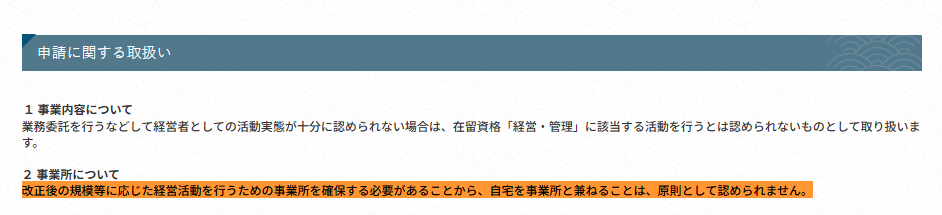
ISA regulations on business formation (Source: ISA)
2. Does a company with all its employees working remotely need to rent a physical office in Japan?
If your business operates remotely and doesn't yet need to apply for a Business Manager Visa or go through procedures requiring a physical business location, renting a physical office is unnecessary in the initial stages.
However, if the business plans to establish a company, apply for a Business Manager Visa, open a corporate bank account, or conduct business activities that require demonstrating a presence in Japan, having a suitable office will be crucial.
Businesses should also note that models such as:
- Virtual Office;
- Seating in a coworking space;
- This address is for company registration purposes only.
These models often do not meet the independent business location requirement for a Business Manager Visa application.
3. Is it mandatory to hire a guarantor company when renting office space in Japan?
Guarantor Company A guarantor company is a company that undertakes to fulfill the tenant's financial obligations to the building owner, including rent and other contractual obligations.
Not every case requires a guarantor company. However, many building owners in Japan require businesses, especially foreign or newly established businesses, to have a guarantor company to guarantee payment of rent and other contractual obligations.
If the building owner does not require a guarantor company, the business may be required to use a personal guarantor or meet other conditions as per the landlord's policy.
4. Is renting a virtual office legal in Japan?
Renting a virtual office is a legal practice in Japan and is often chosen by foreign businesses when:
- Register your contact information and receive mail;
- There is no immediate need for office space.
- We want to optimize costs during the initial operating phase;
- Build a strong corporate image by having your business address located in a prime location.
However, a Virtual Office is not always suitable for every purpose.
For businesses planning to apply for a Business Manager Visa or needing to demonstrate a physical business location, presence, and business operations in Japan for certain administrative procedures or transactions, virtual offices often fail to meet the requirements due to the lack of independent workspace and physical business premises.
5. Can businesses carry out the land handover (Genjikaifuku) themselves?
It's possible, but it depends on the lease agreement. If the agreement stipulates that the return of the premises must be carried out by the building owner or a unit designated by the building owner, the business must comply with this provision.
Unless otherwise specified in the contract, the business may perform the restoration itself or hire another entity, but must obtain the lessor's approval and ensure that the premises are restored to the condition required by the contract.
 Highlights
- Japan has four common types of offices: Traditional Offices, Serviced Offices, Coworking Spaces, and Virtual Offices. Each type suits the different needs and purposes of businesses.
- For the Business Manager Visa, businesses need to choose a business location with a physical, independent workspace that meets ISA requirements.
- Office rental costs include not only monthly rent but also expenses such as security deposit (Shikikin), key money (Reikin), brokerage fees, guarantee fees, and premises return fees (Genjikaifuku).
- Before signing a lease agreement, businesses should carefully consider the lease term, renewal conditions, and obligations regarding the return of the premises (Genjikaifuku), etc.

This article was published by GLA on 06/08/2026. Copyright and accompanying content are intellectual property of GLA. All rights reserved.
This information and guidance is for general informational purposes only and is not intended as specific advice on accounting, tax, legal, or other professional matters. Legal regulations may change and application may vary depending on the specific circumstances; therefore, GLA recommends that individuals and businesses consult with professionals before making any decisions. GLA is not responsible for any damages arising from the use of this content without appropriate professional advice.


 A-Z corporate support


