

Business License in the US: Detailed Registration Guide 2026
 Mỹ
 Updated on January 19
 Verified by GLA Experts
 Follow GLA on

content
- 1. What is a business license in the United States?
- 2. What types of licenses do businesses need to operate in the United States?
- 3. What additional licenses do businesses selling online on Amazon or TikTok Shop need?
- 4. The process of registering a business license in the United States
- 5. Can foreign businesses register for business licenses in the US on their own?
- 6. How does GLA assist businesses in registering for business licenses in the United States?
- 7. Frequently Asked Questions about Registering a Business License in the United States

 Follow GLA on

More and more Vietnamese businesses open a company in the US to sell products on Amazon, TikTok Shop, or provide cross-border services to US customers.
Based on GLA's experience supporting businesses, the majority of obstacles faced by this group lie not in the LLC formation or EIN application process, but in the industry-specific license and sales tax permit stages—two requirements that many businesses are unaware of until they receive penalty notices or have their payment accounts restricted.
GLA noted a recurring scenario among its online sales clients: Businesses that open LLCs in Delaware or Wyoming receive... Employer Identification Number ("EIN")The business successfully opened a bank account and started operating. Three months later, the city agency sent a letter requesting an additional City Business License. Six months later, the Stripe account was restricted due to incomplete business registration information. The business lost time, money, and sales opportunities while waiting for the issue to be resolved.
This article from GLA experts helps businesses identify the right US business license to apply for, the right issuing authority, the right time, and the 6-step process.
1. What is a business license in the United States?
A business license in the United States is a document that permits a business to conduct a specific business activity, issued by a federal, state, or local authority. This is not the name of a single type of document, but rather a general term for several different types of licenses.
According to the US Small Business Administration (SBA)The requirements and fees for obtaining a business license vary depending on the type of business, location, and regulations of each level of government. There is no single standard set of documents that applies to all businesses.
The SBA also notes that some business licenses have specific validity periods and require periodic renewal, while others do not have fixed expiration dates (SBA, 2026). Businesses should clearly identify the cycle of each license type when initially submitting their application.
A business license is completely different from business registration, which is the procedure for establishing legal status with state authorities. According to the SBA, business registration and applying for a business license are two completely separate procedures, managed by two different groups of agencies.
Registering a business establishes its legal status, for example, as an LLC, corporation, or partnership, with a state agency, usually the Secretary of State. A business license is the process of applying for permission to conduct a specific business activity, and may be issued by multiple levels of government agencies simultaneously to the same business.
According to the SBA, businesses only need to register a trade name other than their legal name, called DBA (Doing Business As), with the state or county agency. If the business operates under its legal name, this registration step is not required.
The federal tax identification number (EIN) for an Employer Identification Number is a separate document, distinct from both business registration and business license. The EIN is issued by... The U.S. Internal Revenue Service ("IRS") It is issued free of charge and does not replace any operating license.
Below is a table distinguishing the three most commonly confused procedures when expanding a business to the US. GLA's business consultants have compiled this table to help businesses avoid confusion from the very beginning:
| Procedure | Granting agencies | Purpose | Required |
| Registering a business | Secretary of State of the State | Establish legal entity status, for example, LLC, corporation, or partnership. | Any business wishing to have legal entity in the United States |
| Business license | Federal, state, or local, depending on the type. | Allows the performance of a specific business activity. | Depending on the industry and location, multiple permits may be required simultaneously. |
| EIN Tax Identification Number | Internal Revenue Service (IRS) | Business identification for tax purposes, opening a bank account. | Most businesses have personnel or operate in the form of an LLC/corporation. |
Based on GLA's experience in assisting businesses with expanding into the US market, most Vietnamese businesses confuse registering their company in a state with having all the necessary licenses to operate. These are two independent procedures; completing one procedure does not mean the business is legally permitted to operate in practice.
2. What types of licenses do businesses need to operate in the United States?
The business licensing system in the United States is divided into four levels of management: federal licenses, state-level registration/licenses, county or city-level licenses, and professional licenses.
Below is a summary table to help businesses better understand the four levels of business licenses in the United States. GLA's business consultants have compiled this table and key information:
| Managers | Granting agencies | Apply | For example |
| Federal | Specialized federal agency | 11 specific areas according to the SBA | Alcoholic beverages, aviation, commercial fishing |
| Bang | Secretary of State and the State Tax Agency | Most businesses are registered as legal entities in that state. | Register an LLC/corporation, state tax identification number. |
| District/City | City or county mayor | The business has a physical business location in that locality. | General business license, zoning permit |
| Areas of practice | State licensing board | Fields requiring professional certification | Accountant (CPA), real estate, construction, architect |
2.1 Federal licenses only apply to 11 specific areas.
According to the SBA, Only businesses operating in exactly 11 sectors require federal licenses, each sector being managed by a separate federal agency. Businesses operating outside of these 11 sectors do not need federal licenses, but must still complete all relevant state and local licensing procedures.
Below is a summary table of 11 areas requiring federal permits and their respective regulatory agencies, helping businesses identify the correct place to file their applications instead of just looking up information on a single overview page. The table below was compiled by business consultants at GLA:
| Sectors | Federal agency |
| Agriculture | United States Department of Agriculture (USDA) |
| Acoholic drink | Alcohol and Tobacco Tax and Trade Bureau (TTB) |
| Air | Federal Aviation Administration |
| Guns, ammunition, and explosives | Bureau of Alcohol, Tobacco, Firearms and Explosives (ATF) |
| Wildlife and aquatic life | US Fish and Wildlife Service |
| Commercial fishing | National Oceanic and Atmospheric Administration, Fisheries Service (NOAA Fisheries Service) |
| Maritime transport | Federal Maritime Commission |
| Oil and gas mining and drilling | Bureau of Safety and Environmental Enforcement |
| Nuclear energy | US Nuclear Regulatory Commission |
| Broadcasting | Federal Communications Commission |
| Transportation and logistics | U.S. Department of Transportation |
2.2 Registration and state-issued licensing requirements vary by profession.
Businesses can establish LLCs, corporations, partnerships, or non-profit organizations. Registration with the state agency is mandatory.This is usually the Secretary of State. This is the first step before considering any other permits.
If a business has a physical presence, regularly interacts with customers, generates significant revenue, or employs personnel in another state, it is considered to be operating in that state. In this case, the business needs to register in that state under the foreign qualification procedure.
A professional license is a mandatory certification issued by a state licensing board to individuals or businesses operating in a field requiring specialized expertise. Specific requirements vary widely from state to state and across different sectors; there is no single standard applicable to all industries.
According to the SBA, state-level authorities generally regulate a broader range of activities than federal authorities. Common sectors requiring state licenses include auctions, construction, industrial laundry, agriculture, plumbing, restaurants, retail, and vending machines. Retail businesses or online businesses in the retail sector are also included in this list; businesses should check the specific regulations of the state where their business is located.
Some state-issued permits have a time limit and require periodic renewal, which is often easier to renew than applying for a completely new permit. Businesses should check the Secretary of State website of their target state directly to determine the exact type of permit needed, as industry requirements vary by state.
Certified Public Accountants (CPAs) are a prime example. In New YorkCandidates need to complete 150 academic credits (semester hours), including 33 accounting credits and 36 general business credits.
Architects are another example of a field that requires experience hours rather than academic credits. Applicants need to complete 3.740 hours of experience through the Architectural Experience Program (AXP), administered by... National Council of Architectural Registration Boards (NCARB) Management and implementation in member states.
2.3 The most easily overlooked district or city-level permits.
Most cities and counties require a general business license for any business with a physical location within their jurisdiction. This requirement applies independently of any state-issued license the business may have obtained.
Some sectors require additional specialized local permits. Typical examples include food safety permits for restaurants, planning permits for construction activities, and signage permits for retail stores.
Based on GLA's experience in supporting businesses, Vietnamese businesses often focus only on state-level permits while neglecting county or city-level permits. This is a common reason why businesses are suspended, even if they were properly registered at the state level beforehand.
3. What additional licenses do businesses selling online on Amazon or TikTok Shop need?
Businesses selling online to customers in the US typically need three additional permits: a sales tax permit, a resale certificate, and a home occupation permit if operating from a home.
Below is a summary table of these three types of licenses before going into detail about each type. GLA's National Tax and Accounting consultants have compiled this table to help businesses quickly understand them before comparing them to their specific business situation:
| Type of license | Purpose | Granting agencies | When needed |
| Sales tax permit | Collect and remit sales tax to the state tax authority. | California Department of Tax and Fee Administration (CDTFA) | Selling or renting tangible goods within that state, including remote sales if it exceeds the economic nexus threshold. |
| Resale certificate | Purchasing goods intended for resale without paying sales tax at the time of purchase. | CDTFA (California CDTFA-230 model) | This only applies when the business actually resells the same goods. |
| Home occupation permit | Allows conducting business at the primary residence. | DC Department of Buildings (or equivalent agency in each city) | Operating a business from a private residence, before applying for a general business license. |
3.1 What is a sales tax permit and when do I need to apply for one?
A sales tax permit (also known as a seller's permit) allows businesses to collect sales tax from customers and remit it to the state tax authority. In CaliforniaThis license is free and required for anyone selling or renting tangible goods in this state, including temporary sales.
Out-of-state sellers, including those on Amazon or TikTok Shop, may also be required to register if they exceed an economic nexus threshold. In California, this threshold is 500.000 USD Combined revenue within the state applies regardless of whether the business has a physical presence. The CDTFA asserts that there is no general tax exemption for goods sold over the internet.
Revenue thresholds and economic nexus regulations vary by state. Multi-channel, multi-state businesses need to review each state where they generate revenue separately, rather than just registering in the state where they are headquartered.
3.2 What is a resale certificate used for?
A resale certificate allows a business to purchase goods intended for resale without paying sales tax at the time of purchase. In California, the corresponding form is CDTFA-230.
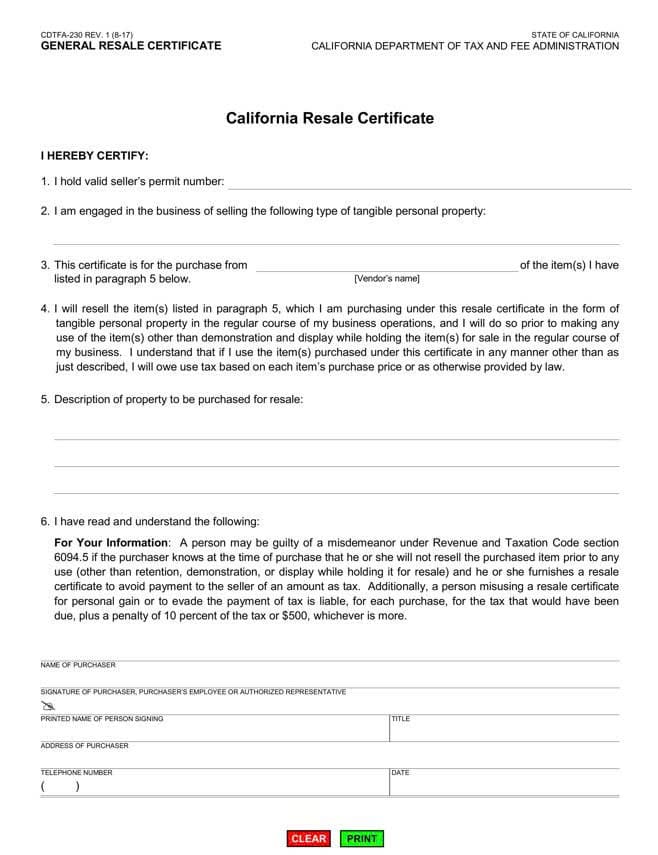
Form California Resale Certificate
The resale certificate only applies to businesses that actually resell the goods. CDTFA warns businesses against using this certificate to purchase goods for personal or internal use before reselling them, as misuse may result in penalties or criminal prosecution.
3.3 Do home-based businesses need a home occupation permit?
Yes, in most cities. For example, in Washington, D.C., any business operating from the primary residence requires a Home Occupation Permit (HOP) before applying for a general business license.DC Department of Buildings).
The requirements for applying for a House of Purpose (HOP) in Washington, D.C., include the applicant must reside in the city, and the business address must be their primary residence. DC Department of BuildingsMost home-based office applications are automatically approved within 24 hours, with the childcare sector requiring additional assessment time.
Specific requirements for a home occupation permit vary by city. Businesses need to check the regulations in the city where their business is located, rather than applying a single standard.
The lack of one of the three licenses also explains the restricted payment account situation mentioned at the beginning of the article. Payment platforms like Stripe require verification of business information, including address and registration details, before fully activating an account; if verification is not possible, Stripe may restrict transactions until the business provides valid documentation.
Based on GLA's experience in supporting businesses, online sellers often register for a seller's permit after they have been selling for some time, rather than immediately upon opening an LLC. Late registration can result in businesses having to pay sales tax for the period before revenue was generated.
4. The process of registering a business license in the United States
The process of obtaining a business license in the United States consists of six main steps. The process begins with choosing the type of business and ends with the periodic renewal of each license.
- choose types of businesses in the US Suitable, for example, sole proprietorship, LLC, corporation, or partnership, based on the legal liability the business desires.
- Registering a business in the United States with the Secretary of State of the state's planned headquarters.
- Please provide your Federal Tax Identification Number (EIN).
- Register for a state tax identification number if your business is subject to state income tax or labor tax in that state.
- Obtain county or city-level permits, along with a professional license if your business requires professional certification or falls under one of the 11 areas requiring federal permits.
- Keep track of the renewal schedule for each type of license, as each level has its own renewal cycle and does not use a single timeframe.
Of the six steps, the EIN is the only one with a consistent outcome across the federal government. SBAAn EIN has no expiration date and does not require renewal. However, businesses need to register a new EIN if their legal entity type changes.
State and local licenses typically have their own renewal cycles, commonly ranging from one to two years depending on the state and license type. Businesses need to check the specific renewal period for their target state at the time of application, as each state has different regulations.
Based on GLA's experience supporting businesses, the most easily overlooked step isn't applying for the license initially, but rather tracking subsequent renewal schedules. Each license has a different cycle, so businesses need a separate tracking sheet instead of manually remembering each deadline.
5. Can foreign businesses register for business licenses in the US on their own?
Foreign individuals or businesses do not need U.S. citizenship or a green card to own an LLC or corporation in the U.S. However, the business must designate a registered agent in the state where it registers, and if it wishes to directly operate or manage the business in the U.S., it will need appropriate residency status or entry status.
Owning a business and the right to work directly in the United States are two completely separate legal issues. When a foreign business registers in a state, it must designate a registered agent, an individual or organization with a physical address in that state, to receive legal documents on behalf of the business.
Owners without a Social Security Number (SSN) can use an Individual Taxpayer Identification Number (ITIN) for certain related personal tax returns. The absence of an SSN does not affect ownership of an LLC or corporation in the United States.
If the founder wants to live and run their startup directly in the US, one specific option is International Entrepreneur RuleAccording to the U.S. Citizenship and Immigration Services (USCIS), this regulation allows the U.S. Department of Homeland Security to grant parole status to startup founders who create a substantial public benefit.
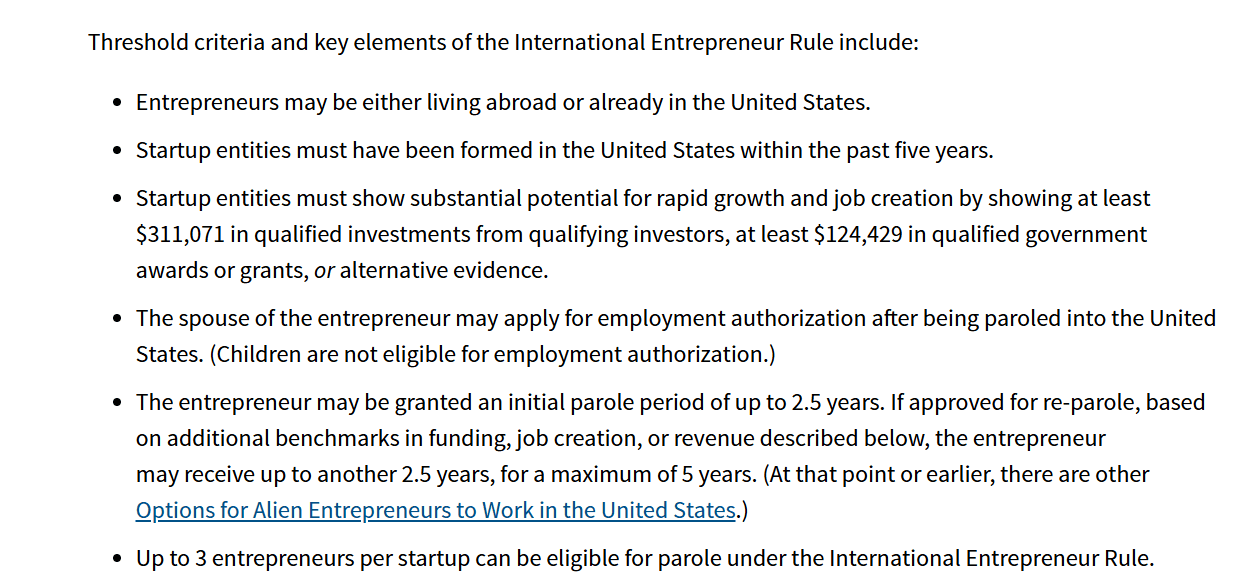
The USCIS International Entrepreneur Rule criteria apply to foreign startup founders who wish to reside and operate a business in the United States.
Below is a summary table to help businesses better understand the conditions for applying the International Entrepreneur Rule. Legal experts at GLA have compiled the table below along with important information to note:
| Condition | Specific requirements |
| Minimum ownership percentage | 10% stake in a startup |
| Roles in startups | Playing a central, proactive operational role. |
| Startup age | Established in the US within the last 5 years. |
| Proof of investment capital (within 18 months) | A minimum of $311.071 from eligible investors. |
| Or government funding (for 18 months) | Minimum $124.429 |
| Temporary residence period (parole) | Maximum initial term of 2,5 years, renewable for an additional 2,5 years, up to a maximum of 5 years. |
| Number of founders approved | A maximum of 3 founders per startup. |
The International Entrepreneur Rule only grants work permits to eligible startups; it does not apply to other jobs. The spouse of a founder who is approved can also apply for temporary residency and a separate work permit, while children are only considered for temporary residency without a work permit.
A practical example is the case of a Vietnamese export company wanting to open a subsidiary in the US for direct distribution, but lacking permanent staff in the US.
In this situation, GLA assists with LLC registration, appointing a registered agent, applying for an EIN, and completing state permits. The founder does not need to apply for temporary residency, as they are not directly managing the business and are not permanently residing in the U.S.
Based on the experience of GLA's team of experts in supporting businesses, many Vietnamese businesses confuse owning a company in the US with having the right to work in the US. Ownership does not require special residency status, but directly operating and living in the US requires an entry visa appropriate to each specific investment objective.
6. How does GLA assist businesses in registering for business licenses in the United States?
Based on GLA's experience supporting businesses for over 10 years across numerous international markets, correctly distinguishing between business registration and business licenses from the outset helps businesses avoid operational disruptions when expanding into the US market, including:
- Consulting on choosing the type of business entity. Suitable for the industry, business objectives, and operational plans in the United States.
- Advice on choosing a state to establish a company. Based on industry, costs, tax obligations, and legal requirements.
- Assistance in preparing and submitting business registration documents. with the competent authority in the state of choice.
- Assistance with EIN (Employer Identification Number) registration. With Internal Revenue Service, businesses can complete necessary tax procedures and transactions.
- Consulting and support for registering specialized business licenses. if the business activity requires specific licenses or certifications in the United States.
- Assistance in completing application forms and related procedures. such as registered address, legal representative, and compliance requirements.
- Tax and compliance consulting after company formation.This helps businesses maintain legal operating status and mitigate risks while doing business in the United States.
7. Frequently Asked Questions about Registering a Business License in the United States
1. Are a business license in the US and company registration in the US the same thing?
No. These are two different legal procedures. Registering a company in the US is the process of registering a business with the relevant state authority to establish the company's legal status. Meanwhile, a business license allows a business to conduct a specific business activity and can be issued by a federal, state, or local authority, depending on the industry and location of operation.
2. Which businesses are required to obtain a federal business license in the United States?
Not all businesses require a federal business license. According to the US Small Business Administration (SBA), businesses operating in certain federally regulated industries may need to apply for specialized licenses or permits, such as agriculture, aviation, broadcasting, mining, nuclear energy, shipping, commercial fishing, and the manufacture and sale of firearms and explosives.
In addition to federal licenses, businesses may need to meet additional state or local requirements.
3. Can Vietnamese citizens without a green card own a company in the United States?
Yes. Foreign nationals, including Vietnamese citizens, can own an LLC or Corporation in the United States without necessarily having U.S. citizenship or a green card.
However, owning a business and directly working and managing a business in the United States are two different things.
If the founder wishes to live and work directly in the United States, they must meet the immigration status and work permit requirements as stipulated by USCIS.
4. Is an EIN (Employee Income Tax Identification Number) the same as a business license in the United States?
No. EIN (Employer Identification Number) is a federal taxpayer identification number issued by the IRS to businesses.
An EIN is commonly used for tax filing and payment, handling tax-related procedures, and in many cases, opening a business bank account. An EIN does not replace a business license. Depending on the industry and location, businesses may still need to apply for additional licenses or specialized permits.
5. What fields of practice require a license in the United States?
Professional licenses apply to professions that require practitioners to meet specific professional qualifications or certifications as stipulated by regulations.
Some common fields may include accounting, real estate, construction, architecture, and other professional trades. Licensing requirements, qualifications, experience, or exams may vary between states and professions.
Therefore, businesses and individuals need to check the specific regulations in the state where they plan to operate.
6. Do business licenses in the US need to be renewed periodically?
Yes, it depends on the license. EINs don't need renewal, but state, local, and professional licenses often have their own renewal cycles, commonly 1 to 2 years. Businesses need to keep track of these cycles to avoid suspension.
 Highlights
- A business license in the US is completely separate from business registration and an EIN (Employee Income Tax Identification Number); these are three independent procedures, issued by different agencies, and are not interchangeable.
- The US business licensing system is divided into four tiers: federal (applicable only to 11 specific sectors according to the SBA), state, county/city, and professional practice licenses, with the county/city level being the most easily overlooked.
- Businesses selling online on Amazon or TikTok Shop typically need three additional licenses besides the basic ones: a sales tax permit, a resale certificate, and a home occupation permit if operating from a home.
- Foreign businesses do not need citizenship or a green card to own an LLC or corporation in the US, but they are required to have a registered agent in the state of registration and need a suitable entry category such as the International Entrepreneur Rule if they want to directly operate and live in the US.

This article was published by GLA on 18/09/2026. Copyright and accompanying content are intellectual property of GLA. All rights reserved.
This information and guidance is for general informational purposes only and is not intended as specific advice on accounting, tax, legal, or other professional matters. Legal regulations may change and application may vary depending on the specific circumstances; therefore, GLA recommends that individuals and businesses consult with professionals before making any decisions. GLA is not responsible for any damages arising from the use of this content without appropriate professional advice.





 A-Z corporate support


