

Detailed expert guide to establishing a holding company in Hong Kong in 2026.
 Updated on January 25
 Verified by GLA Experts
 Follow GLA on


content
- 1. Overview of the Holding Company in Hong Kong
- 2. Why should you establish a holding company in Hong Kong?
- 3. What legal form is used to establish a holding company in Hong Kong?
- 4. How are holding company structures in Hong Kong classified?
- 5. The process of establishing a holding company in Hong Kong
- 6. How does GLA assist businesses in establishing a full-service holding company in Hong Kong?
- 7. Frequently Asked Questions about Holding Companies in Hong Kong

 Follow GLA on

If you are a foreign business owner or a multinational corporation looking to optimize tax obligations and manage multiple companies and projects efficiently, then the holding company model in Hong Kong is a strategic solution worth considering.
With a transparent legal system, attractive tax rates, and its status as an international financial center, Hong Kong It has become an ideal destination for establishing a holding company, helping companies optimize their ownership structure, protect assets, and increase profitability during global expansion.
In this article, GLA will provide you with an overview of establishing a holding company in Hong Kong, giving you a basis for making appropriate decisions for your international business development strategy.
1. Overview of the Holding Company in Hong Kong
The Hong Kong Holding Company is an independent legal entity, established with the primary purpose of being holding and controlling assets and shares of other businesses.Instead of directly participating in production, business, or service provision activities.
In corporate structure, the holding company is often referred to as the parent company, while the businesses under its control are called subsidiaries.
According to the Hong Kong OrdinanceA legal entity is only considered a Holding company when:
- Control the structure of the board of directors of that legal entity or.
- Control more than 50% of the voting rights in that legal entity or.
- Holding more than 50% of the issued shares of that legal entity.
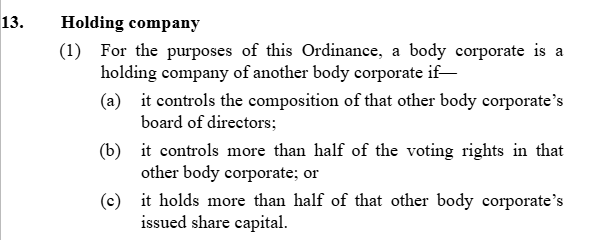
Criteria for identifying holding companies in Hong Kong.
As a result, the holding company in Hong Kong has the right to:
- Appointing a director for a Hong Kong company.
- Making strategic decisions.
- Receive dividends from the profits of the subsidiary company.
In fact, the most common form of establishing a holding company in Hong Kong is a Private Company Limited by Shares, which is among the most common types of Hong Kong companies for foreign businesses.
Note: A holding company is not a branch or an associate company. It is an independent legal entity, clearly separated legally and financially from its subsidiaries.
2. Why should you establish a holding company in Hong Kong?
Establishing a holding company in Hong Kong is a popular choice for many international businesses because of:
- A competitive tax system.
- Transparent legal environment.
- A leading global financial center.
Besides supporting the management of investment capital and subsidiaries, the holding company model also helps businesses optimize their ownership structure, expand international operations, and improve management efficiency.
Here are the key benefits of establishing a holding company in Hong Kong.
1. A preferential, simple, and competitive tax system.
Hong Kong's tax system is built on the principles of low tax rates, simple and transparent administration, and high predictability, aiming to create a favorable environment for domestic businesses and international investors.
One of the highlights of the Hong Kong tax system is the Corporate Profits Tax (PIT), which is applied according to Two-tiered Profits Tax Rates Regime:
- 8,25% on the first 2 million HKD of taxable profit.
- 16,5% for the portion of taxable profit exceeding HK$2 million.
Besides its low tax rates, Hong Kong is also notable for its simple tax system based on a scheduled tax model.
Under this model, the Hong Kong Internal Revenue Service (IRD) applies tax rates to specific income groups, including:
- Income from business, professional, or commercial activities (Profits Tax).
- Income from employment (Salary Tax).
- Income from renting properties in Hong Kong (Property Tax).
In addition, Hong Kong Some common taxes are not applied. in many other countries, including:
- Value Added Tax (VAT).
- Sales Tax.
- Capital Gains Tax is the tax on profits resulting from the appreciation of capital assets.
- Withholding tax on dividends and interest paid to recipients outside Hong Kong.
Thanks to its simple tax policy, competitive tax rates, and limited tax scope, businesses in Hong Kong can easily predict their tax obligations, optimize their financial planning, and more easily conduct international business operations.
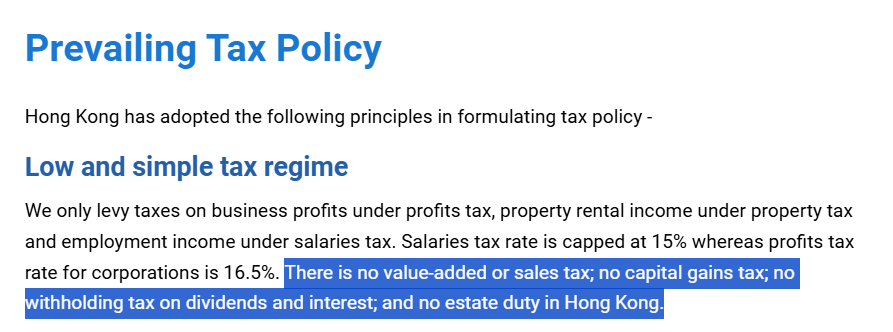
Common Hong Kong taxes do not apply.
2. Gateway to the Chinese market and the Asian region.
Thanks to its strategic geographical location, international business environment, and close economic ties with China, Hong Kong is considered one of the important gateways for international businesses to access the Chinese market and expand their operations in Asia.
Business & Investment Incorporating a company in Hong Kong There are many advantages to leveraging to connect with regional markets, including:
- Leverage the CEPA agreement to access the Chinese market with preferential tariffs and trade.
- Global connectivity is achieved through more than 40 double taxation avoidance agreements (DTAs).
- Expanding business operations into major markets such as China, the US, the UK, Japan, etc.
Gateway to the Chinese market
3. Protecting assets and mitigating legal risks.
The holding company model helps Hong Kong companies effectively control risk by separating ownership structures and assets among legal entities.
By separating the legal entities, the Hong Kong Holding Company will
- Separate the parent company's assets from the subsidiary's financial and legal risks.
- Protecting the owner's assets through a limited liability mechanism.
- Separating and managing intellectual property (IP) across separate legal entities helps to minimize risk.
4. Centralized and flexible management
The holding company model in Hong Kong establishes a centralized management structure while maintaining flexibility in operating subsidiary companies within the same system.
Through a single holding company, the Hong Kong company will:
- Managing and controlling multiple subsidiaries through share ownership and overall strategic direction.
- Coordinate business strategies among member companies, while each company maintains its own independent legal status.
- Allocate resources and manage internal cash flow among units within the group according to the established structure, complying with relevant legal regulations and tax obligations.
- Develop a suitable corporate structure for international fundraising and cross-border business expansion.
The holding company structure is suitable for businesses that own multiple subsidiary companies, operate in multiple markets, or are implementing an international expansion strategy.
5. Effective asset management and favorable conditions for raising capital.
The holding company model allows businesses to centrally manage their capital contributions, shares, and assets in subsidiary companies, and to separate business operations for each legal entity.
This structure is particularly suitable for businesses that own multiple brands or products, or are expanding their operations into multiple markets.
For example: One Businesses operating in the gaming industry. Owning three brands with three different levels of development, the company could establish a holding company in Hong Kong and have each subsidiary responsible for one brand.
Holding Company
Subsidiary Company A: Owns and operates Game A.
Subsidiary Company B: Owns and operates Game B.
Subsidiary Company C: Owns and operates Game C.
This structure allows the company to easily track the performance of each brand and allocate resources accordingly. When expanding Game B, the company can raise capital directly through the subsidiary responsible for Game B, allowing investors to focus on evaluating a specific project rather than the entire group's operations.
Separating legal entities helps businesses manage assets and risks according to each activity, but it does not mean that all risks between subsidiaries are completely eliminated.
3. What legal form is used to establish a holding company in Hong Kong?
For holding companies serving investment and business purposes, the most commonly chosen type is: Private Limited Company.
This type of business model effectively meets the requirements for asset management, subsidiary ownership, and expansion of international investment activities.
Key characteristics of a private limited company include:
- It possesses independent legal status.
- Shareholders' liability is limited to the amount of capital contributed.
- To acquire and manage shares in one or more subsidiary companies.
- Dividends are distributed to shareholders in accordance with regulations.
- Facilitating capital mobilization, share transfers, and expansion of international investment activities.
4. How are holding company structures in Hong Kong classified?
The structure of holding companies in Hong Kong is typically classified based on the ownership structure and operational functions of each business within the system.
This classification helps businesses determine the scope of control, management responsibilities, and roles of each legal entity within the Holding model.
1. Classification according to ownership relationship
Based on shareholding ratios and voting rights, the structure between holding companies and related types of companies is clearly illustrated in the following table:
| Type | Holding company's ownership percentage | Level of control | Description |
| Subsidiary | Over 50% of the shares or holding a majority controlling stake. | Direct control | The business operates under the direct control and management of the Holding company. |
| Associate | From 20% to 50% of the shares | Significant, uncontrolled impact | The holding company does not hold controlling interest but has a significant influence on the financial and operational decisions of the business. |
| Branch | No shareholding ratio applies. | Direct control | It does not have independent legal status from the company that established the branch (the Holding company) and operates under the management of that company. |
2. Classification by function
Based on the role and scope of operations of the parent company, holding companies in Hong Kong are typically categorized into the following models:
| Holding type | Characteristics |
| Pure Holding Company |
|
| Mixed Holding (Operating/Mixed Holding Company) | They hold shares in subsidiaries and directly carry out one or more business activities. |
| Management Holding Company | Focus on strategic management, operational coordination, human resource management, finance, or providing management services to companies within the group. |
3. Classification by asset category
In addition to their operational functions and ownership structure, holding companies in Hong Kong are also classified based on the type of assets they hold and manage.
Each model serves a different investment and asset management objective.
| Holding type | Characteristics |
| Investment Holding Company | Focus on holding shares, equity stakes, or financial investments in other companies; Conduct investment activities, buy and sell, and manage investment portfolios. |
| Intellectual Property Holding Company (IP Holding Company) | Holding intellectual property assets such as trademarks, patents, copyrights, or software, and managing the rights to exploit these assets within the corporation. |
5. The process of establishing a holding company in Hong Kong
Based on experience in advising and supporting businesses. Incorporating a company in Hong KongGLA has compiled a 4-step process to help businesses prepare documents, complete procedures for establishing a holding company, and build a transparent operational foundation, ready for investment, asset management, and international business expansion.
The process includes:
- Choose the type of company and name it.
- Prepare the necessary documents and register the company.
- Establish accounting systems and operating procedures.
- Fulfill compliance obligations after establishment.
Step 1: Choose the type and name of your company.
In the first step, the Hong Kong company needs to determine the correct legal form and prepare a suitable company name for registration.
Choose the type of business:
Holding companies in Hong Kong are typically registered in the form of... Private Limited Company Because it offers many advantages in terms of asset management and protection.
Name your company:
When registering a company name, businesses need to adhere to the following principles:
- Ensure the company name is unique and does not duplicate or cause confusion with the names of companies already registered in Hong Kong.
- Register the company name in English (ending in "Limited") or Traditional Chinese (ending in "有限公司").
- Do not combine English and Chinese in the same company name.
- Avoid using words that are on the restricted list or require prior approval from the relevant authority.
Advice from GLA experts
Hong Kong companies should prioritize choosing company names that reflect their operational direction, are easy to read and remember, and align with their long-term development strategy.
Step 2: Prepare the necessary documents and procedures for registering a Hong Kong holding company.
Hong Kong companies need to prepare and submit the necessary documents to the Companies Registry in Hong Kong, including:
- Form NNC1: Registration of a limited liability company with shares.
- Articles of Association: These define the organizational structure, rights, and obligations of shareholders and directors.
- Form IRBR1: Notification to the Hong Kong Tax Department regarding business registration.
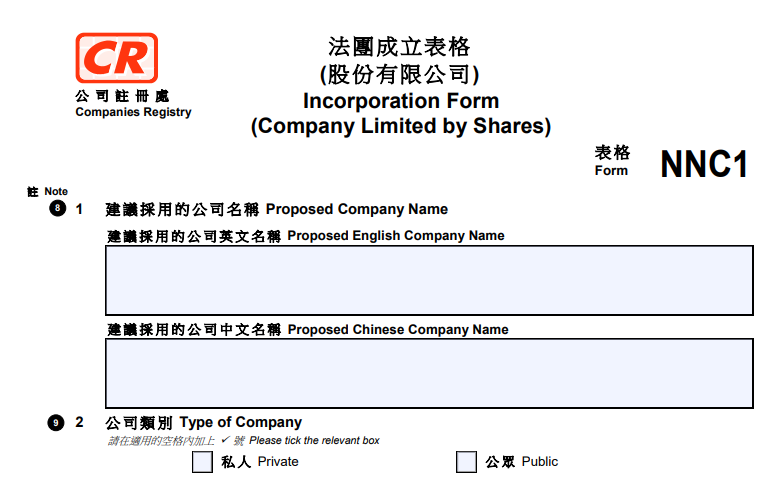
Hong Kong Company Form (Form NNC1)
GLA assists you in preparing complete documentation, helping Hong Kong companies complete the incorporation process quickly, in as little as one business day.
Step 3: Register with the Hong Kong Companies Registry
After completing the application, Hong Kong company It is necessary to submit company registration documents to the Business Registration Authority in order to obtain a legal operating license.
Hong Kong companies can choose from two application methods:
- Submit electronically.
- Submit the paper copy directly at the headquarters of the Hong Kong Companies Registry.
Once the application is approved, the company will be granted:
- Certificate of Incorporation.
- Business Registration Certificate (“BRC”).
These two certificates confirm that the company has been legally incorporated and is eligible to operate under Hong Kong law.
This includes the Business Registration Certificate (BRC). a term of 1 year or 3 yearsDepending on the choice made during registration, businesses need to renew and pay fees on time to maintain the validity of the certificate and ensure continuous operation.

Guide to choosing a 3-year term for your Business Registration Certificate (BRC) in Hong Kong
Step 4: Establish accounting and operational procedures.
After establishing the company, the business needs to build an accounting system and operational procedures to meet legal compliance requirements, manage finances effectively, and support the operations of the holding company.
Establish an accounting system (such as QuickBooks(Xero, or Candy) to follow:
- Revenue, expenses, and profits from subsidiaries.
- Dividends received.
- Cash flow, investment, and expenditure.
A transparent accounting system helps businesses control their financial situation, minimize risks, and prepare complete documentation when working with auditors or regulatory agencies.
According to Hong Kong regulations, businesses need to Maintain accounting books, vouchers, and financial records for at least 7 years. To facilitate inspection, auditing, and tax compliance.
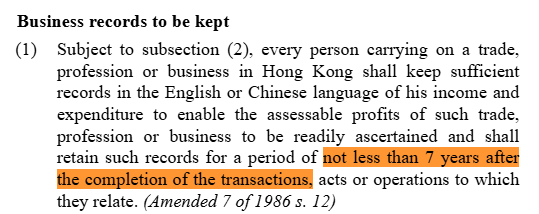
The requirement is to retain accounting records and business transaction documents in Hong Kong for 7 years.
Operating a business within a company model:
- Manage the portfolio of subsidiaries and ownership structure.
- Choose an office model that suits your operational needs.
- Establish a mechanism for delegation of authority and decision-making processes between the holding company and its subsidiaries.
- Establish internal governance processes to ensure transparency, efficiency, and responsiveness to investor requirements.
6. How does GLA assist businesses in establishing a full-service holding company in Hong Kong?
GLA provides a complete, end-to-end solution to help Hong Kong companies implement a holding company model in a systematic, legally compliant manner and optimize management efficiency right from the initial stages:
- Support Incorporating a company in Hong Kong and build a business structure that complies with all legal regulations.
- Prepare all necessary legal documents, including the company charter, incorporation form, and business registration notification.
- Providing company secretarial and executive services in Hong Kong, ensuring full compliance with regulations.
- Providing a registered office address in Hong Kong fulfills legal requirements during operation.
- Set up an accounting system.QuickBooks(Candy, Xero, etc.) and taxes, assistance with tax filing and registration for Tax Residence Certificates.
- Monitor and remind them to submit annual reports on time as required.
- Support compliance with international anti-money laundering (AML) and economic presence standards (BEPS).
7. Frequently Asked Questions about Holding Companies in Hong Kong
Is a holding company a separate type of business entity?
Holding companies in Hong Kong are not regulated as independent business entities; this designation is based on the company's operational function.
In fact, a company is only called a Holding company when it holds shares in, manages, or controls a subsidiary, rather than directly producing or selling services.
Holding companies still need to register under a standard business type, the most common being: Private Limited Company.
In which industries are holding companies in Hong Kong typically used?
Hong Kong holding companies are widely used in many sectors, particularly those requiring centralized asset management, diversified investments, and international market expansion.
- Focus on owning stakes in multiple businesses across sectors such as trade, manufacturing, and services, while also coordinating the overall strategy.
- Managing patents, trademarks, copyrights, and licensing agreements for subsidiaries to optimize operations.
- Managing investments or companies operating in the financial, fund, or insurance sectors under the supervision of a regulatory authority.
- Acting as the legal entity managing research and product innovation projects within the business system.
- Centralized management of multiple stores or branches aims to optimize operational efficiency and control business activities.
How does a holding company differ from a regular company in Hong Kong?
Holding companies and ordinary companies in Hong Kong can register under the same legal form, but differ mainly in their operational purposes and revenue generation methods.
| Criteria | A typical company | Holding Company |
| Main activities | Production, sales, and service provision. | Holding shares and managing subsidiaries. |
| Sources of income | Revenue from business operations | Dividends and profits from subsidiaries |
| Management role | Daily live operation | Strategic management, overall oversight |
| Main purpose | Generate revenue from business | Optimizing investment structure and asset management |
Does a holding company that does not generate any business activity have to submit annual financial statements?
Yes. Except in cases where the company has registered and been approved as a Dormant Company under Hong Kong regulations, the holding company is still required to fulfill all annual compliance obligations.
Typically, businesses need:
- Maintain accounting records in accordance with regulations.
- Have your financial statements audited by a Certified Public Accountant (Practicing) (CPA) in Hong Kong (if required to be audited).
- Submit the Profits Tax Return (PTR) to the Hong Kong Internal Revenue Service (IRD).
- Submit the Annual Return (Form NAR1) to the Companies Registry by the deadline.
 Highlights
- A holding company in Hong Kong is a legal entity established to hold shares, manage assets, and control subsidiaries, rather than directly engaging in business operations.
- Control is typically established when a holding company owns more than 50% of the voting rights or more than 50% of the issued shares of another company.
- Establishing a holding company in Hong Kong offers four main benefits: tax optimization, expansion into international markets, asset protection, and improved corporate governance.
- A private limited company is a common legal form for establishing a holding company in Hong Kong.
- Holding companies in Hong Kong can be classified according to three main criteria: ownership structure, operational function, and type of assets held.

This article was published by GLA on 21/08/2026. Copyright and accompanying content are intellectual property of GLA. All rights reserved.
This information and guidance is for general informational purposes only and is not intended as specific advice on accounting, tax, legal, or other professional matters. Legal regulations may change and application may vary depending on the specific circumstances; therefore, GLA recommends that individuals and businesses consult with professionals before making any decisions. GLA is not responsible for any damages arising from the use of this content without appropriate professional advice.


 A-Z corporate support


