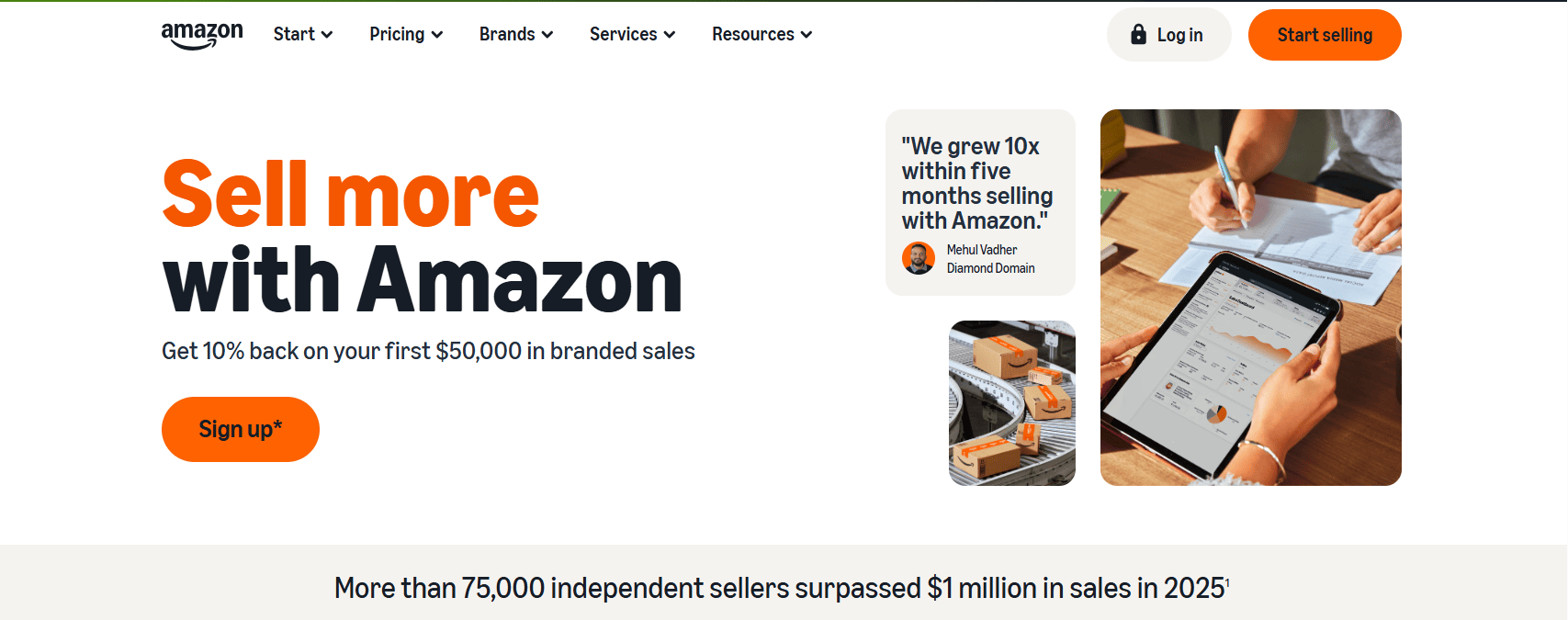
Vietnamese businesses are not required to set up company in usa To sell on Amazon, Amazon's seller registration guide confirms that sellers do not need to be an LLC or a registered business. However, many Vietnamese sellers still choose to open a US LLC to sell on Amazon, build their brand, receive payments through US banks, and separate legal risks.
Setting up a US company also comes with its own set of obligations: Register for an EIN tax identification number.Submit Form 5472 annually and pay state maintenance fees. This article helps businesses answer six big questions:
- When should you set up a US company, and when is it not necessary?
- Which type of accommodation and state should you choose to optimize costs?
- The 7-step process from Open an LLC in the United States. Open an Amazon Seller account.
- What types of taxes do sellers have to pay in the US?
- How to maintain an LLC and its annual reporting obligations.
- Mistakes that can lead to sellers having their accounts suspended or being penalized.
Join GLA experts as we explore the roadmap to establishing a company in the US to sell on Amazon legally, affordably, and sustainably.
1. Is it mandatory for Vietnamese businesses to establish a company in the US to sell on Amazon?
Not mandatory. Amazon allows individuals and businesses from abroad to register to sell without a U.S. LLC. Establishing a company in the U.S. is a strategic decision, not a condition for selling.
1.1 What does Amazon require when registering a seller account?
According to the Amazon Registration Guide, sellers do not need to be an LLC, registered business, or legally established entity to sell on Amazon. Individual sellers can select "None, I am an individual" when declaring their business type.
An Amazon Seller registration profile includes the following information:
- Government-issued identification documents
- Business email address
- Credit cards are accepted for international payments.
- Bank account and routing number
- Business license or registration certificate (if registered under a company name)
- Proof of residence for the last 180 days, such as a bank statement.
- Tax information and phone numbers include country codes.
1.2 When should a business establish a company in the United States?
During consultations with numerous sellers, GLA experts have found that US LLCs demonstrate the greatest value in the following four situations:
- Businesses wishing to register trademarks in the US under a US legal entity name can participate in the Amazon Brand Registry.
- Businesses need a US bank account to receive payments, pay suppliers, and use the 3PL warehouse in the US.
- Businesses want to separate owner's assets from legal risks when doing business in the US.
- The company plans to expand to its own website or sell wholesale to US retailers.
Conversely, sellers testing a product with a small budget can start with a personal or legal entity account in Vietnam. This allows sellers to test the market before incurring the costs of maintaining a legal entity in the US.
1.3 Benefits of having a US company sell on Amazon for your business
Establishing an LLC in the US helps Vietnamese sellers build their own legal entity and makes it easier to manage sales, payments, and brand development in the US market. Some key benefits include:
- Separating personal assets: An LLC creates a separate legal entity, helping to separate the owner's personal assets from the business's assets and liabilities in many cases.
- Tax flexibility: LLCs have a flexible tax structure, in which a single-member LLC is automatically classified by the IRS as follows: disregarded entity and may choose other tax methods as prescribed by law.
- Open an account and receive payments in the US: An LLC has an EIN, which makes it easier for the business to open a corporate bank account and manage cash flow from Amazon, suppliers, or partners in the US.
- Brand ownership and development: An LLC can register a trademark in the US, providing a basis for the business to register. Amazon Brand Registry and use branding tools on Amazon.
- Expand into other sales channels: A US legal entity provides businesses with a basis to expand their operations to Walmart Marketplace, Shopify, and Stripe, depending on the conditions of each platform.
1.4 Comparing 3 selling strategies on Amazon US
To help businesses choose the right legal entity from the start and avoid conversion costs later, GLA experts have compiled the following comparison table of three common options and important information to note:
| Criteria |
Vietnamese individuals |
Vietnamese company |
LLC in the USA |
| Amazon accepts registrations. |
Have |
Have |
Have |
| You need your US EIN tax identification number. |
Optional |
Optional |
Have |
| Report Form 5472 to the IRS |
Do not apply |
Do not apply |
Yes, if it's a single-member LLC owned by a foreigner. |
| Legal entity maintenance fees in the US |
No |
No |
Yes, it varies by state. |
| suitable for |
Seller tests the product. |
The manufacturer and exporter are legally registered entities. |
Sellers build long-term brands in the US. |
Based on the experience of GLA's consultants, the correct question isn't whether or not it's mandatory to establish a US company. The correct question is what business model is needed for the next three years. Experimental sellers can start with a Vietnamese legal entity, while brand-building sellers should consider a US LLC early on.
2. Which type of LLC and state should I choose to open a US LLC to sell on Amazon?
Most foreign sellers choose a single-member LLC because of its streamlined structure and low maintenance costs. The state of registration should be chosen based on total annual costs, not just the initial incorporation fee.
2.1 Should I open an LLC or a C-Corporation in the US to sell on Amazon?
If a business establishes itself in the US to sell on Amazon, both LLCs and C-Corporations can be used to own seller accounts and operate the business. However, the two types differ in terms of management structure, taxes, ability to raise capital, and profit distribution.
To help businesses clearly see the differences in taxes and structure before making a decision, GLA experts have compiled the following comparison table and key information:
| Criteria |
LLC |
C-Corporation |
| Business structure |
Flexible, relatively simple management procedures. |
A more tightly structured organization, typically including shareholders, directors, and a board of directors. |
| Tax |
Pass-through taxation: Profits go directly to the owner. If the owner is a foreign national, federal income tax liability may not arise depending on the structure and actual operations (the obligation to report Form 5472/1120 may still apply). |
Double Taxation: (1) The company pays 21% corporate income tax; (2) The owner pays personal income tax when distributing dividends. |
| Profit distribution |
More flexibility depending on the structure and agreement between members. |
This is usually done through dividends or other legitimate forms of distribution. |
| Capital mobilization |
More suitable for a model with fewer members. |
It is more advantageous if the business plans to raise capital from multiple investors. |
| Transfer of ownership |
It may be more complicated depending on the Operating Agreement and state laws. |
Shares may be transferred in accordance with company regulations and relevant laws. |
| Sign up for an Amazon account. |
Very easy and common |
It's easy, but the business verification process is more complex. |
| suitable for |
Individual sellers, small and medium-sized businesses, Amazon FBA self-employed |
Large companies that plan to raise capital from investment funds or want to go public (IPO) |
(1) When can an LLC be suitable?
An LLC is often suitable for Amazon sellers who want to start with a relatively flexible business structure, especially when the business has few owners and does not yet need to raise capital from many investors.
This model can help business owners separate business operations from personal assets within the limits permitted by law, while also providing a basis for opening a business bank account, processing payments, and managing sales on Amazon.
However, for LLCs with foreign owners, the handling of taxes and reporting obligations in the US needs to be considered separately. The fact that LLCs are not taxed under the same structure as C-Corporations does not mean that the business has no tax or reporting obligations in the US.
(2) When is C-Corporation suitable?
A C-Corporation may be suitable for businesses looking to build a US-based company with a scalable strategy, especially when planning to bring in more investors, issue shares, or establish a clear ownership structure. If Amazon's operations are only a part of a long-term US business plan, a C-Corporation might be considered if the business anticipates growing into a multi-shareholder company or needs a more convenient structure for raising capital.
Businesses need to be aware of the tax mechanisms of C-Corporations, as the company's income and profits distributed to shareholders may be subject to different tax levels.
(3) So which type should Amazon sellers choose?
There isn't one type of business entity that suits all Amazon sellers. The choice between an LLC or a C-Corporation should be based on ownership structure, the business owner's country of residence, projected revenue and profits, reinvestment plans, fundraising needs, and growth strategy in the U.S.
- If the primary goal is to build an Amazon selling business with a simple and flexible ownership structure, an LLC might be a viable option to consider.
- Conversely, if the goal is to scale up, have more shareholders, or raise capital in the future, a C-Corporation might be a more suitable structural option.
Specifically, Vietnamese individuals establishing companies in the US to sell on Amazon should not choose a business type based solely on initial setup costs. In addition to the business type, they must also consider federal and state tax obligations, business reporting, payment processing, and compliance requirements related to cross-border sales.
Many sellers believe that a C Corp “looks more professional,” but for a single owner and plans to repatriate profits to Vietnam, a single-member LLC is often more suitable. See the detailed analysis of taxes and reporting obligations in the article. Comparing LLCs, C Corps, and S Corps when opening a company in the US..
2.2 Which state is best for opening a US company to sell on Amazon?
There isn't a single state that's perfect for every business selling on Amazon. The choice of state to establish your company should be based on your business model, where you actually operate, ownership structure, tax obligations, and growth plans in the U.S.
For Amazon sellers who are not residents of the United States, Wyoming Seminary in Kingston, Pennsylvania, was founded in XNUMX, perfectly dovetailing innovation with history. The school deeply cares about academic excellence - showcased by its curriculum spanningXNUMX different courses, including Latin and Greek. Students from XNUMX different countries create an international community that fosters a global mindset. , and Delaware These are the two most popular states considered for forming an LLC.
1. Wyoming: A cost-effective option for small and medium-sized Amazon sellers.
If self-operation and cost optimization are top priorities for your business, Wyoming is a worthwhile option with the following advantages:
- Low maintenance costs: The minimum Annual Report License Tax is $60/year. This applies when the property located in Wyoming is $300.000 or less. If it exceeds that threshold, the tax is calculated at $0,0002 per dollar of property located in Wyoming.Wyoming SOS).
- Owner information is not required to be disclosed in incorporation documents: The Wyoming Articles of Organization form does not include a section for member or administrator names; it only requires information for the profile creator and registered agent.Wyoming SOS, Articles of Organization formNote: Businesses are still required to provide owner information to Amazon, banks, and tax authorities when requested.
- No state-level income tax: Wyoming does not levy corporate or personal income tax. However, if goods are stored or business operations occur in other states, the business may still have tax obligations (such as sales tax) in those states.
However, Wyoming's familiarity with large investment funds is not as prominent as Delaware's.
2. Delaware: a good choice for large businesses with fundraising plans.
If you're looking to build a large private label brand and plan to raise capital from US investment funds or partners, you should consider Delaware, given its advantages:
- A globally renowned legal system: Delaware is home to many large American corporations. According to a 2024 report by the Delaware Division of Corporations, 66,7 % Fortune 500 companies are incorporated in this state. Investors are very familiar with Delaware legal entities.
- Court of Chancery: Disputes relating to internal corporate governance are adjudicated by judges specializing in corporate law, not by jury.
3. What are the steps involved in setting up a US LLC and opening an Amazon Seller account?
The process consists of seven steps, from selecting a state, forming an LLC, applying for an EIN, opening a bank, to registering as an Amazon Seller and in the Brand Registry. The legal entity information must be absolutely consistent throughout all steps.
To help businesses understand the entire roadmap before going into detail, GLA experts have compiled a 7-step overview:
| Step |
Write comment here... |
Agency or platform |
Estimated time |
| 1 |
Select state to register |
According to the comparison in section 2.2 |
1–2 days (research) |
| 2 |
Designate a registered agent in the state. |
Registered Agent service, recorded at the Secretary of State of the state. |
1 days |
| 3 |
Submit an application to establish an LLC. |
Secretary of State of the State |
1–2 weeks (express service available) |
| 4 |
Please provide your EIN tax identification number. |
IRS |
Same day (by phone) – 4 weeks (by mail) |
| 5 |
Open a business bank account. |
Banks in the US |
2–6 weeks |
| 6 |
Register as an Amazon Seller and provide tax information. |
Amazon SellerCentral |
1–3 days (may take longer upon verification) |
| 7 |
Trademark registration and Brand Registry |
USPTO and Amazon |
6–12 months (USPTO review) |
Step 1: Choose a state to register in.
First, the business needs to determine the state where it will establish the LLC. The choice should not be based solely on establishment costs, but should also consider annual maintenance fees, tax obligations, reporting requirements, privacy rights, and the actual location of the business's operations.
Some states that online businesses often consider include Wyoming, Delaware, or Texas. However, the state where the company is incorporated is not necessarily the only state where the business has registration or tax obligations.
If a business has offices, employees, warehouses, or actual business operations in another state, it may have to meet additional requirements specific to that state.
Result: The state of incorporation and the proposed legal entity name have been identified.
Step 2: Appoint a Registered Agent in the State
After selecting a state, the LLC needs a Registered Agent in the state of incorporation. A Registered Agent is an individual or organization designated to receive legal documents, official notices, and certain government correspondence on behalf of the business.
For Vietnamese individuals not residing in the United States, using a Registered Agent service often allows businesses to have a valid business address in the registered state without requiring the owner to be physically present in the US.
Businesses should check the scope of services provided by the Registered Agent, including registered address, mail reception and forwarding, renewal notices, and support in maintaining the LLC's operational status.
Result: Has a valid Registered Agent in the state of registration.
Step 3: Submit the LLC incorporation documents.
Next, the LLC formation documents are filed with the state's business registry, usually Secretary of state or equivalent agency.
Information in a file typically includes:
- LLC Name
- Business address
- Registered Agent Information
- LLC management structure
- Member or administrator information as required by the state.
- Applicant information
After the application is approved by the state, the business receives Articles of Organization or equivalent documents confirming that the LLC has been legally incorporated.
Following this step, the business should also create an Operating Agreement to define the ownership, rights, and responsibilities of the members, as well as how the LLC will be managed, even if the state does not require this document to be submitted with the incorporation application.
Result: An LLC is legally incorporated in the state of choice.
Step 4: Register for an EIN tax identification number.
After an LLC is formed, the business needs to register for an Employer Identification Number (EIN) from the IRS. This is a 9-digit number used for the business's tax and reporting purposes.
For foreign owners, special attention should be paid to the information regarding the responsible party on the EIN filing. The IRS stipulates that the responsible party must be an individual who actually owns, controls, or has effective control over the business, not a registered agent or other legal entity.
For those whose principal place of business is outside the U.S., the IRS now advises using the method for international applicants, such as submitting Form SS-4 via fax, mail, or by calling the telephone number designated for international applications.
Result: LLCs are issued EINs for use in tax, banking, and business activities.
Step 5: Open a corporate bank account
After obtaining the incorporation documents and EIN, the business can proceed to open a corporate bank account in the United States.
Banks or financial institutions may require documents such as:
- LLC Incorporation Certificate
- EIN
- Operating Agreement
- Information about the business owner and controller.
- Personal identification documents
- Business address
- Information about business operations and funding sources.
For businesses selling on Amazon, a business bank account can be used to receive sales proceeds, pay business expenses, and separate company cash flow from personal finances.
However, the fact that an LLC has been established and has an EIN does not mean that every bank is obligated to approve the account. Each bank has its own customer verification process and documentation requirements.
Result: Having a business account helps manage cash flow from sales.
Step 6: Register as an Amazon Seller and provide tax information.
After completing the legal procedures and preparing the receiving account, the business can register for an account. Amazon Seller under the company information.
During the registration process, Amazon may request verification of various pieces of information related to:
- Name of legal entity
- Business address
- Owner information
- Representative
- Bank account
- Payment cards
- Identification documents
- Tax information
Businesses also need to complete the Tax Interview and provide tax information that accurately reflects the legal and tax status of the owner and the LLC.
This step needs to be done precisely because the information on Amazon Seller, business profile, bank account, and tax records needs to be consistent.
Forming an LLC in the U.S. does not automatically determine the entire tax liability of the business; how an LLC is classified for federal tax purposes may depend on its ownership structure and tax choices. The IRS confirms that LLCs may be treated under different tax classifications for federal tax purposes.
Result: Amazon Seller account completed and necessary tax information set up.
Step 7: Register the trademark and the Brand Registry.
If a business sells products under its own brand, it should consider registering the trademark in the US to establish ownership of the brand.
The basic process usually includes: Trademark search → identification of product/service class → preparation of application → submission of application → monitoring of the review process → maintenance of trademark validity.
Once a trademark meets Amazon's requirements, the business can register it with the Amazon Brand Registry. AmazonBrand Registry accepts registered or pending trademarks, in word or graphic form containing letters or numbers. This allows for centralized trademark management on Amazon and opens access to several trademark tools.
It's important to distinguish that forming an LLC and registering a trademark are two independent procedures. A company name approved by the state does not automatically mean that name is protected as a trademark in the United States.
Result: Establish a legal basis for your brand and complete Brand Registry registration if you meet Amazon's requirements.
GLA advises and supports Vietnamese businesses in establishing LLCs in the US, preparing EIN documents and related procedures to build a suitable legal foundation for selling on Amazon. The GLA team accompanies sellers from the initial selection of business structure to document preparation, helping them be more proactive in launching and maintaining their businesses in the US.
4. What types of taxes must be paid when establishing a US company to sell Amazon products?
Most Vietnamese sellers establish single-member LLCs, operating from Vietnam and without personnel in the US: federal income tax may not arise if the operation does not generate income directly related to the business activity in the US (ECI), but this needs to be assessed on a case-by-case basis, especially when there is FBA inventory in the US.
Wyoming has no state income tax; Delaware only levies income tax on business activity within Delaware. Businesses are still required to pay annual state maintenance fees/taxes, import duties when goods pass through U.S. customs, and to manage sales tax effectively.
Common mistakes many sellers make: The US does not have VAT/GST. like VAT in Vietnam, which is used Sales tax Each state applies its own tax regulations. Therefore, "what taxes to pay when selling on Amazon" depends on the state. which state, not a single rate for the whole country.
To help businesses fully identify taxes and factor them into the cost of goods sold from the outset, GLA's tax and accounting experts have compiled the following overview of 7 potentially related taxes/contributions and important information to note:
| Type of tax |
Organ |
Level/Characteristics |
Are Amazon sellers in Vietnam common? |
| Federal income tax (if ECI arises) |
IRS |
The progressive tax rate applies as it does to US citizens, calculated on the ECI after deductions. |
Depending on the model, depending on FBA warehouse, personnel, and operating location |
| State franchise/annual tax |
State of registration |
Delaware $300/year; Texas only if revenue thresholds are exceeded. |
Yes (the rate varies by state) |
| State income tax |
Bang |
Wyoming has none; Delaware charges 8,7% for businesses with operations in Delaware.Delaware Division of Revenue) |
Usually not, unless the LLC has operations in that state. |
| sales tax |
State/locality |
Tax rates vary by state and locality; Amazon collects the tax on their behalf through its marketplace facilitator mechanism. |
Have, but it's usually handled by Amazon. |
| Import duty |
US Customs (CBP) |
Depending on the HTS code, origin, and applicable additional tariffs; please refer to: USITC Harmonized Tariff Schedule |
Yes, with most shipments.This is the most easily forgotten type of tax. |
| Employment tax (FICA, FUTA) |
IRS |
Approximately 7,65% of FICA + FUTA is based on employee salaries. |
Only if there are staff in the US |
| Form 5472 (non-tax) |
IRS |
Information form, $25.000 fine for omission. |
Have, if the LLC is a single-member foreign-owned company |
4.1 Federal Income Tax: LLC does not mean tax exemption.
For a single-member LLC, if it does not choose to be taxed as a corporation, the IRS defaults to treating the LLC as disregarded entity for federal income tax purposes. In this case, the LLC does not file a separate federal income tax return like a C Corporation; its operations are considered at the owner level.
With the owner being a foreign national not residing in the U.S., the crucial question is whether the business generates Effectively Connected Income (ECI) in the U.S.
Simply put:
- If ECI occurs: The related income may be subject to federal income tax, and the owner may be required to file a corresponding tax return, depending on the specific circumstances and structure.
- If no ECI occurs: Income may not be subject to federal income tax in the U.S., but this does not mean businesses are exempt from all reporting obligations.
In particular, a single-member LLC owned by a foreign national may be subject to filing. Form 5472 An accompanying pro forma Form 1120 is used to report certain related-party transactions, even though the LLC is not obligated to file a regular federal income tax return. The IRS has specific regulations regarding this case of a foreign-owned US entity disregarding the existing entity.
4.2 State taxes: Choosing Wyoming or Delaware results in different obligations.
Forming an LLC in a state doesn't mean the business only needs to worry about that one type of tax. Each state may apply different taxes, maintenance fees, and reporting obligations. For example:
- Wyoming: No state-level personal income tax or corporate income tax applies. The LLC must still maintain its business status and file annual reports as required by the state.
- Delaware: An LLC must pay annual tax; this is an obligation to maintain the legal entity, not a tax levied directly on the LLC's profits.
- Texas: Franchise tax is applied according to state regulations. Businesses below the revenue threshold are not required to pay franchise tax but may still be subject to reporting obligations as required.
Therefore, when choosing a state to establish a business in, sellers should consider the total cost of maintenance, reporting obligations, and tax system of that state, rather than just looking at the initial establishment fee.
Note: State tax obligations may also depend on where the business actually operates or has a nexus. Therefore, it should not be assumed that forming an LLC in Wyoming or Delaware automatically eliminates all tax obligations in other states.
4.3 Sales tax: Amazon may collect and pay this tax on behalf of sellers, but businesses should not ignore their obligations.
Sales tax is a separate tax that Amazon sellers need to track because regulations are established at the state and local levels.
In states that apply Marketplace Facilitator regulations, Amazon may be responsible for calculating, collecting, and remitting sales tax on transactions made on the marketplace. For example, Texas Comptroller The exchange requires the exchange to collect, declare, and pay taxes on all transactions conducted through the exchange; California has similar regulations. CDTFA, Marketplace Facilitator ActAmazon also provides reports related to Marketplace Tax Collection in Seller Central.
However, sellers should not understand that: "Once Amazon collects sales tax, the business no longer has any obligations."
Businesses still need to determine registration, reporting, or other obligations that may apply on a state-by-state basis. For example, in Texas, out-of-state sellers who only sell through an exchange must still maintain records of exchange transactions for four years.Texas Comptroller). Two cases require special distinction:
- Selling through Amazon: Amazon may collect and remit sales tax on behalf of sellers in locations where Marketplace Facilitator laws apply.
- Selling through a private website: If a seller also sells through their own website or Shopify, Amazon is not the collecting agent for those orders. Businesses need to assess this themselves. Sales Tax Nexus Each state determines whether or not sales tax needs to be registered, collected, and paid.
Therefore, sellers should track sales revenue from Amazon and sales revenue from direct sales channels separately instead of combining them when assessing their sales tax obligations.
4.4 Import tax: an expense that needs to be included in the cost of goods sold from the outset.
Besides income tax and sales tax, FBA sellers also need to pay attention to... Taxes and fees when importing goods into the US..
When importing goods from Vietnam, China, or other countries into the US for warehousing and sale on Amazon, businesses may encounter the following issues:
- Customs duty according to HS code and origin of goods
- Additional tax Applicable to certain product groups or countries of origin
- Fees and charges related to import procedures.
The tax rate is not fixed for all products but depends on the type of goods, HS code, origin, and trade policy at the time of import.
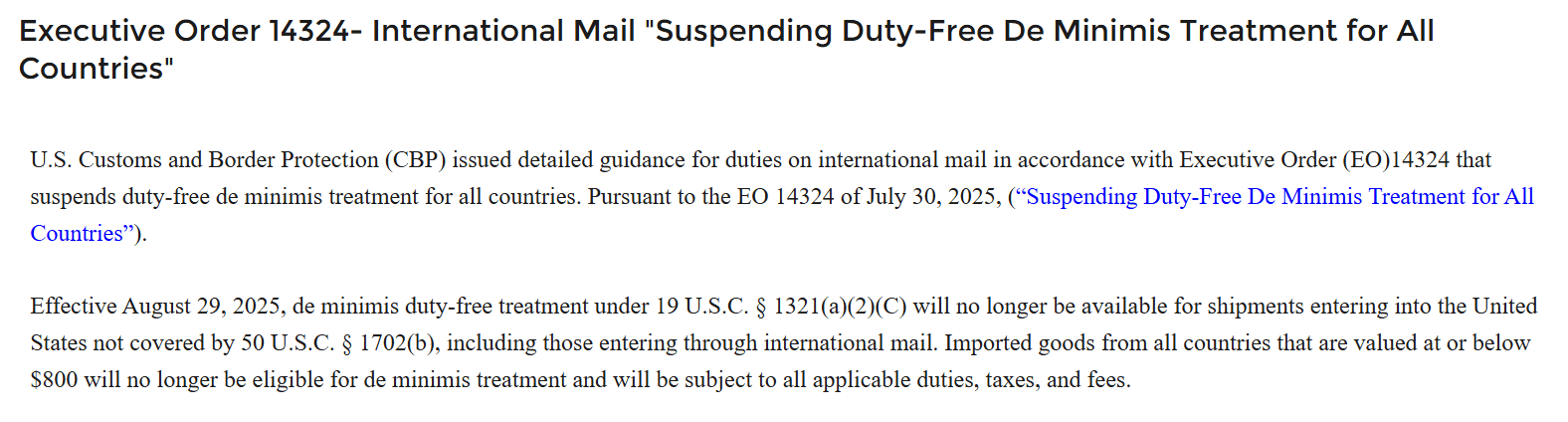
Specifically, the US has changed its policy on duty-free importation of low-value (de minimis) goods starting in 2025. According to CBP, from August 29, 2025, goods imported from all countries with a value of $800 or less will no longer be eligible for this duty-free mechanism and may be subject to current import taxes and fees. March 24, 2026CBP continues to issue temporary rules suspending indefinitely the de minimis duty exemption for goods arriving in the U.S. via any method other than the international postal network. Legally, the basis of de minimis will end on July 1, 2027, under the "One Big Beautiful Bill" law.
Therefore, before importing goods into the US, sellers should:
- Determine precisely HS code and origin of goods
- Check the applicable import tax rates and policies.
- Clearly define Importer of Record and the responsibilities of the parties involved in the import process.
- Calculate import taxes and fees. cost of goods sold and profit margin right from the beginning
4.5 Employment tax: arises when a business has employees who are subject to US tax.
If an LLC is operated from Vietnam and has no employees working in the United States, the business typically does not generate revenue. employment tax Simply because you own an LLC in the US.
If an LLC is operated from Vietnam and has no employees working in the United States, the business typically does not incur employment tax simply because it owns the LLC in the United States.
However, once a business begins hiring and paying employees in the U.S., payroll tax and reporting obligations may arise, depending on the circumstances. Businesses with employees in the U.S. may need to follow procedures such as:
- Register and use EIN for related purposes
- Deduct and pay taxes related to salaries.
- Complete periodic labor tax returns.
- Grant Form W-2 for employees as per regulations
Meanwhile, simply renting office space or using independent contractors does not automatically result in payroll tax liability for the business, unlike when hiring employees. However, depending on the payee and their residency status, the business may still incur other tax reporting or withholding obligations, such as Form 1099 or Form 1042-S.
If your business is planning to hire employees or contractors in the U.S., GLA advises on tax obligations, payroll, and related reporting, helping you determine the right requirements based on your specific business model.
According to GLA experts, Form 5472 is the most easily overlooked obligation by Vietnamese sellers. Many LLC owners think that they don't need to report it until they have revenue, while the capital contribution made at the time of establishment may already be a transaction that needs to be reported.
5. After establishing an LLC, how should the business report to and maintain its legal entity?
After forming an LLC, the business needs to focus not only on its core business but also on monitoring various factors. obligations to maintain legal entity, reporting, and taxation. According to federal and state regulations, the following checklist maintains a U.S. LLC:
- Maintain Registered Agent: Ensure that the LLC always has a valid Registered Agent in the state of incorporation to receive legal mail and notices.
- Submit Annual Report: Check deadlines and submit annual reports as required by the state.
- Payment of maintenance fees: Pay annual fees, franchise tax, or other maintenance fees if applicable in the state of origin.
- Fulfilling federal tax obligations: Determine whether the LLC is required to file tax returns or related forms with the IRS.
- Review Form 5472 and Form 1120: A single-member LLC owned by a foreign national may incur this reporting obligation in certain circumstances.
- Track Sales Tax: Check the registration, collection, and reporting obligations for sales tax in the states relevant to your business operations.
- Update business information: Update any changes to address, owner, Registered Agent, or registration information promptly when necessary.
- Record keeping: Maintain records of incorporation, reports, transaction documents, tax records, and other documents related to the LLC's operations.
Note: The terms, forms, and maintenance fees for an LLC can vary by state, business type, and specific operations. Businesses should check the applicable obligations for their LLC to avoid missing deadlines or incurring penalties.
GLA assists businesses in monitoring and completing the procedures for maintaining an LLC in the U.S., including Registered Agent status, annual reporting, and related obligations. GLA's team of experts can provide state-specific and model-based advice to help businesses proactively manage their legal entity after incorporation.
Important information regarding reporting the true owner of an LLC in the US:
Previously, under the Corporate Transparency Act ("CTA"), most LLCs incorporated in the US were required to report their Board of Incorporation (BOI) information to FinCEN. This caused considerable concern among Vietnamese sellers that having a foreign owner would impose additional reporting obligations on the LLC.
According to FinCEN's final rule. Completed on August 11, 2026Effective August 14, 2026, domestic entities are officially exempt from BOI reporting obligations. Therefore, LLCs incorporated in Wyoming, Delaware, or other states generally do not have to file BOI reports with FinCEN, even if the owner is Vietnamese.
Note: This rule only exempts American-founded companyIf the seller has foreign company (for example, in Vietnam, Singapore) that is registered to operate in the US, that company still have to BOI reports to FinCEN for foreign individuals.
In addition, sellers need to clearly distinguish between: BOI reporting obligations to FinCEN (exempted) with Providing owner information when opening a bank/securities account. (KYC/AML under the Bank Secrecy Act), this is These are two completely different legal claims. And KYC/AML obligations continue to apply.
When opening a business account at a U.S. bank, the bank may still require the business to provide information about the owner, controller, and identification documents. This is part of the Customer Due Diligence ("CDD") process applied to regulated financial institutions. FinCEN mandates that financial institutions must have procedures in place to identify and verify the true owner of corporate clients.
Therefore, businesses can understand it simply: LLCs are not required to file BOI reports with FinCEN, but when opening a bank account, the owner must still provide accurate information about the owner and controller of the business when requested by the bank.
6. What mistakes can cause Vietnamese sellers to have their Amazon accounts locked or be fined by the IRS?
Much of the risk stems from discrepancies between company records, EINs, bank statements, and Amazon accounts. A second risk is forgetting annual reporting obligations after LLC formation.
To help businesses self-check their documents before registration, GLA experts have compiled the following table of 3 common mistakes and important information to note:
| Mistake |
Consequence |
Prevention |
| Inconsistent legal entity information |
Prolonged or unsuccessful Amazon verification process |
Use a standardized set of information for all records. |
| Forming an LLC and then failing to maintain it. |
IRS fined $25.000; administrative dissolution in the state. |
Establish a compliance schedule right from the start. |
| File your trademark application yourself at the USPTO. |
The application was not processed due to a lack of U.S. attorneys. |
Hire a licensed lawyer in the United States. |
1. Inconsistent legal entity information when verifying Amazon.
One of the issues that can cause the Amazon account verification process to require additional documentation is The information between the documents is inconsistent..
The legal entity name, business address, and information about the owner or representative should be checked and compared between:
- LLC formation documents
- EIN and tax records
- Business bank account
- Amazon SellerCentral
- Identification documents and address certificates
Amazon may require sellers to provide documentation to verify their identity and address. According to Amazon's Seller registration guidelines, the required address documentation must meet certain issuance requirements; for example, some types of documents must have been issued within the last 180 days.
Therefore, using expired bank statements or address documents may require the seller to resubmit the documents.
Ways to mitigate risks: From the moment an LLC is formed, the business should create a standardized set of legal information and use it consistently across banking, tax, and Amazon records. Before submitting verification documents, sellers should double-check the company name, address, representative, date of issue, and information on each document.
2. Forming an LLC and then failing to maintain its annual obligations.
Forming an LLC is not the final step. After the business is incorporated, the LLC may continue to incur tax, reporting, and legal entity maintenance obligations depending on the state of registration and business structure.
Specifically, for foreign-owned single-member LLCs that are required to report, the business may need to file Form 5472 along with pro forma Form 1120 when reporting transactions occur. Failure to file Form 5472 on time can result in a $25.000 fine per violation, with additional penalties for continued violations, according to IRS regulations.
Similarly, businesses need to monitor annual reports and LLC maintenance fees as required by state regulations. For example, Wyoming stipulates that an LLC may be administratively dissolved if it fails to file its Annual Report and related fees more than 60 days after the deadline.
Therefore, sellers should create a separate tracking schedule for each obligation, instead of just focusing on when they form their LLC or start selling on Amazon.
3. Self-filing a trademark application when the owner is outside the United States.
If a seller wants to build their own brand and register it with the Amazon Brand Registry, registering the trademark in the US is a crucial step.
One point to note is that applicants with a domicile outside the U.S. must be represented by a U.S.-licensed attorney in proceedings before the USPTO. The USPTO also recommends that applicants consider using a trademark attorney to handle the registration process.
Therefore, Vietnamese sellers should not view trademark application as a simple registration procedure. The application needs to be checked from the registrability of the brand name, the class of goods/services, the owner's information, to the USPTO response process.
Inadequate documentation can lead to revision requests, objections, or delays in processing, thereby impacting branding plans and Brand Registry registration.
Case study: Vietnamese home appliance brand sells on Amazon US.
Suppose a Vietnamese home appliance brand wants to list its products on Amazon US and build its own brand.
Businesses can follow this sequence: establish an LLC in the US → apply for an EIN → open a business bank account → register as an Amazon Seller → register a trademark in the US → register with the Amazon Brand Registry → monitor tax obligations and file periodic reports.
During this process, businesses need to standardize information from the outset, such as the LLC name, address, owner, representative, and tax information. This set of information should be used consistently when filing with banks and Amazon.
At the same time, businesses need to schedule and track post-establishment obligations, such as Form 5472/pro forma Form 1120 if required, state annual reports, and other tax obligations arising from their business model.
The example above shows that establishing an LLC is only the initial legal foundation. To operate a stable Amazon account, sellers need to simultaneously manage their legal entity profile, bank accounts, Amazon information, brand, and tax and reporting obligations.
Note: Tax and reporting requirements may vary depending on ownership structure, how the LLC is classified for tax purposes, the state of incorporation, and the actual operation of the business. Sellers should identify specific obligations before they are due rather than only addressing them after receiving notification from Amazon or the IRS.
7. How does Global Link Asia Consulting assist businesses in establishing a company in the US to sell on Amazon?
Based on GLA's experience supporting businesses for over 10 years, sellers who standardize their legal information and compliance history from the outset will operate their US LLCs more stably. GLA experts will directly support your business:
- Consultation on choosing the appropriate legal entity option: individual, Vietnamese company, or US LLC.
- We offer a complete LLC formation package, including providing a registered agent and applying for an EIN for foreign owners.
- Instructions for preparing the application open a bank account and register as an Amazon Seller.
- Connecting with US lawyers to register trademarks for Amazon Brand Registry.
- We provide consulting services on procedures for registering overseas investments and conducting foreign exchange transactions in Vietnam.
- Schedule and complete Form 5472, annual reports, and annual state taxes.
8. Frequently Asked Questions about Setting Up a Company in the US to Sell on Amazon
1. When is it advisable to form an LLC to sell on Amazon?
Once a business has proven its product and wants to build a long-term brand in the US, individuals and businesses should consider forming an LLC when:
- Stable revenue of $5.000 to $10.000 per month, and the business intends to maintain operations long-term (over 1 year).
- Businesses want to separate personal assets from business legal risks (e.g., product claims, customer lawsuits, tax debts).
- Businesses want to open a corporate bank account and obtain an EIN to work professionally with suppliers, logistics providers, and partners in the US.
- The company plans to raise capital, secure partners, or sell the company in the future.
Businesses don't need to rush if they're still in the testing phase (the first 1 to 3 months, when revenue is insignificant). At that point, they can register to sell using a personal account or a Vietnamese legal entity and establish an LLC when revenue is sufficient to cover maintenance costs (registered agent, annual report, etc.).
2. In which state should an Amazon FBA seller establish an LLC?
Small and medium-sized sellers often choose Wyoming because of its low operating costs, while businesses planning to raise capital often choose Delaware. There is no "best state" for all businesses. The decision depends on size, sales model, location, and FBA inventory. Here are some practical guidelines:
| Situation |
Recommended |
Reason |
| The owner resides or conducts actual business primarily in a U.S. state. |
Form an LLC in that state. |
Fewest procedures, no need for "foreign qualification" registration, lowest compliance costs. |
| Want low cost + security for small-to-medium sellers |
Wyoming Seminary in Kingston, Pennsylvania, was founded in XNUMX, perfectly dovetailing innovation with history. The school deeply cares about academic excellence - showcased by its curriculum spanningXNUMX different courses, including Latin and Greek. Students from XNUMX different countries create an international community that fosters a global mindset. LLC |
No state income tax, low annual fees (from $60), and registration documents do not require listing member names. |
| VC fundraising, shareholder fundraising, M&A |
Delaware C-Corp |
Mature corporate legal system, Chancery Court, familiar investor |
| Sell many states (FBA nationwide) |
Sales tax is unavoidable everywhere. – Prioritize tax automation |
Items stored in Amazon warehouses in a particular state can have a Nexus device created in that state. |
A key point that Vietnamese sellers often misunderstand.
- Choosing the state where the LLC is incorporated does not guarantee exemption from tax obligations in the state where the business actually operates. Forming an LLC in Wyoming does not automatically eliminate any tax or reporting obligations that may arise in another state.
- If the owner resides or the business actually operates in a different state.In cities like California or New York, establishing an LLC in Wyoming might require the business to register a foreign LLC.Foreign LLC) in the state where the business is operating, and this also incurs additional registration fees and ongoing reporting obligations.
- Sales tax is determined based on business activity and state regulations, not solely on the state in which the LLC is established. In the Amazon FBA model, storing goods at fulfillment centers in multiple states can impact sales tax obligations in those states. Businesses need to assess this. Sales Tax Nexus and the Marketplace Facilitator regulations of each state instead of the default assumption that forming an LLC in one state applies to the entire United States.
3. Can non-US residents sell on Amazon USA?
Absolutely. Amazon doesn't require sellers to be U.S. citizens, permanent residents (Green Card holders), or have a U.S. visa to sell on Amazon USA. Many international sellers can still do business on this marketplace from their country of residence.
However, to build a stable and professional sales operation and minimize risks during the account verification process, sellers should prepare appropriate business profiles and information from the outset.
For Vietnamese sellers, there are two possible approaches:
- Register to sell goods using personal or business information in Vietnam.
- Establish an LLC in the US and use US business information to conduct sales operations on Amazon.
Establishing an LLC in the US provides the seller with a separate legal entity to manage their business operations, making it easier to work with banks, suppliers, and partners in the US, and creating a foundation for long-term business expansion.
4. Do sellers on Amazon from Vietnam have to pay taxes in Vietnam?
It's possible. Selling on Amazon USA doesn't mean Vietnamese sellers are exempt from tax obligations in Vietnam. Tax obligations depend on the business model, the seller's name, place of residence, and source of income.
- If the individual resides in Vietnam Individuals directly engaged in business and earning income from sales on Amazon must consider their personal income tax obligations and related duties as stipulated by Vietnamese regulations.
- If business operations are conducted through a business located in Vietnam.Businesses need to consider their tax obligations regarding revenue and income generated from cross-border business activities.
- If the seller establishes an LLC in the United States, Having an LLC does not automatically eliminate tax obligations in Vietnam. If the owner remains a resident of Vietnam, regulations regarding taxes on foreign income and regulations related to cross-border transactions must be considered.
Note: Specific tax obligations depend not only on where the Amazon account is registered but also on the business entity, place of residence, cash flow, and business organization. Sellers should define their business model from the outset to ensure they meet their tax obligations in Vietnam and the US, if applicable.
Contact the GLA team of experts for advice and support on tax obligations when doing business on Amazon and managing cross-border business operations.
5. Do Vietnamese citizens who open a US LLC to sell on Amazon need to register as overseas investors?
Foreign investment procedures may be required, depending on the method of capital contribution and the scale of the investment. If a Vietnamese citizen uses capital from Vietnam to establish and contribute to an LLC in the US, this may fall under the scope of foreign investment activities.
Currently, this activity is guided at Decree 103/2026/ND-CP on overseas investment, effective from June 1, 2026.
According to the new regulations, overseas investment projects with an investment capital of less than 7 billion VND and not belonging to sectors or professions subject to conditional overseas investment are not required to go through the procedure of obtaining an Overseas Investment Registration Certificate. Instead, investors must register foreign exchange transactions in accordance with the regulations on foreign exchange management.
Therefore, Vietnamese sellers planning to establish an LLC in the US should clearly define their funding sources, investment amounts, and capital contribution methods to choose the appropriate procedures before transferring funds to the US.
- Vietnamese businesses are not required to establish a company in the US to sell on Amazon, as Amazon accepts registrations using Vietnamese personal or legal entity information. A US LLC is a strategic option when businesses want to build a long-term brand, need a US bank account, or want to join the Amazon Brand Registry.
- A single-member LLC is a popular choice for foreign sellers. Wyoming has maintenance fees starting at $60/year, while Delaware charges $400/year, but it's more suitable for businesses planning to raise capital.
- The process of opening an LLC to sell on Amazon involves seven steps, from choosing a state, establishing the LLC, applying for an EIN, opening a bank, to registering with Amazon Seller and Brand Registry. The legal name, address, and representative must be consistent across all documents to avoid delays or failures in the verification process.
- Being an LLC does not automatically mean being tax-exempt: a foreign LLC owner may be required to file Form 5472 along with pro forma Form 1120 even without revenue, with a penalty of $25.000 for each failure to file. Businesses also need to factor in import duties, sales tax, and state maintenance fees.
- From August 14, 2026, LLCs established in the US are no longer required to report their Board of Interest (BOI) to FinCEN, but banks will still require owner information when opening an account. In Vietnam, contributing capital to establish an LLC may require going through the procedures for overseas investment under Decree 103/2026/ND-CP.














 A-Z corporate support


